Download
1 / 23
230 likes | 356 Views
Explore the fascinating world of complex numbers, introduced by mathematicians to take the square root of negative numbers. This guide delves into the definition and standard form of complex numbers, characterized by a real part and an imaginary part (e.g., 5 + 4i). Learn how to add, subtract, multiply, and divide complex numbers using polynomial methods and the properties of conjugates. Understand how complex numbers stretch our imagination and their applications in various mathematical fields.

E N D
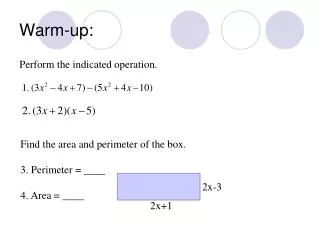
Warm-up: Perform the indicated operation. Find the area and perimeter of the box. 3. Perimeter = ____ 4. Area = ____ 2x-3 2x+1
A long long time ago, in a math class far, far away.. There was no way to take the square root of a negative number
Every time we squared a negative number We got a positive.
(-1) = 1 (-2) = 4 (-3) = 9
Was there a number, that when multiplied by itself Gave you a negative???
Can we in fact, take the square root of a negative number? WE CAN!!!!
Ladies and Gentlemen of Geometry I present to you a NEW number... A number so complex...
It stretches the imagination.. I present to you:
So here’s what the math people did: They used the letter “i” to represent the square root of (-1). “i” stands for “imaginary” So, does really exist?
Complex Numbers • A complex number has a real part & an imaginary part. • Standard form is: Real part Imaginary part Example: 5+4i
Adding and Subtracting complex numbersDo just like polynomial adding or subtracting Ex: Ex:
MultiplyingDo just like polynomial multiplication but when you finish change i2 to -1 Ex: Ex:
Conjugates: Two complex numbers of the form a + bi anda – bi are conjugates. The product is always a real number Ex:
Dividing Complex Numbers • Multiply the numerator and denominator by the conjugate of the denominator.