### Advanced Stiffness Control in Robotic Motion: Techniques and Applications ###
This document outlines the advanced control mechanisms used in robotics, focusing on stiffness and impedance control techniques. It details how prioritizing force versus position can impact performance, the implementation of stiffness control for joint movement, and the application of grasp matrices for whole-body control. Special emphasis is placed on leg phasing during weight transfer and establishing balanced forces during different phases of motion. The presented models and calculations provide insights into the intricate balancing acts required in robot dynamics, vital for enhanced robotic behavior in varied environments. ###

### Advanced Stiffness Control in Robotic Motion: Techniques and Applications ###
E N D
Presentation Transcript
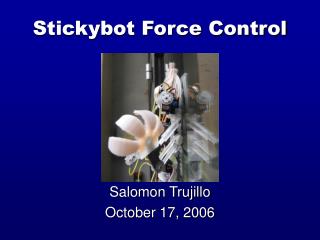
Stickybot Force Control Salomon Trujillo October 17, 2006
Outline • Force vs. Position Control • Implementing Stiffness Control • Whole Body Control: Grasp Matrices • Performing Weight Transfer Between Feet • Leg Phasing
Force vs. Position Prioritizing Desired force and position might contradict. The comprise is implemented through stiffness control. High stiffness gives priority to position. Low stiffness gives priority to force.
Impedance Control mx’’ + bx’ + kx = Fmotor Fmotor = Kmx’’ + Kbx’ + Kkx (m-Km)x’’ + (b-Kb)x’ + (k-Kk)x = 0 Kk = (kphysical-kdesired), Km = Kb = 0 Physical system: Control law: Resulting system: Stiffness Control:
Stiffness-Controlled Servo Xpos fload = kdsrdxpos xpos = xcmd + (fload ÷ kphys) xcmd = (fload ÷ kdsrd) - (fload ÷ kphys) xcmd = fload ÷ kgain kgain = (kdsrdkphys) ÷ (kdsrd - kphys) Xpos Xcmd = kphys kdsrd fload fload
Commanding a Force & Position Xpos Xff-cmd = Xpos – Fdsrd÷ kphys Xfb-cmd = (Fload – Fdsrd) ÷ kgain KGain = (kdsrdkphys) ÷ (kdsrd - kphys) Xcmd Actuator: Servomotor Receives Position Command Sensor: Hall Effect Returns spring displacement kphys fload Feed-forward: Feed-back:
f1 f2 fTOT fTRQ fINT2 fINT3 1 1 1 1 1 -1 1 -1 1 1 -1 -1 1 -1 -1 1 f1 f2 f3 f4 X1 X3 X2 X4 = f3 f4 G 1-D Grasp Matrix
f1 f2 X1 X3 X2 X4 f3 f4 Force Balancing:Grasp-Coupled Stiffness Matrix fi = kixi f=Kx f = (G-1KgrspG)x K = (KdsrdKphys) (Kdsrd - Kphys)-1
1 1 1 1 1 -1 1 -1 1 1 -1 -1 1 -1 -1 1 1 0 0 0 0 1 1 0 0 1 -1 0 0 0 0 1 f1 f2 X1 X3 X2 X4 f3 f4 Grasp Matrix Transitions G4: All legs in contact G2: Two legs (2 & 3) in contact
Not in contact with the wall In contact with the wall Weight Transfer During Trot xcmd = xpos – K-1physfdsrd + (G-1K-1grspG)(fload – fdsrd) 1 2 • Legs 1 and 4 make contact with the wall. G4 becomes active. • Weight is transferred from one pair to the other. 3 4 • Legs 2 and 3 release from the wall. G2 becomes active.
Not in contact with the wall In contact with the wall Leg Phasing During Trot LF RF LB RB Attach Legs in stance might lose phase due to force balancing. Stroke Center During weight transfer, all legs move in unison Detach Phase is restored during flight
Questions? Where can I find a good burger around here?