Comprehensive Overview of Java Primitive Types and Basic Concepts
This guide provides a thorough overview of fundamental Java concepts, focusing on primitive types such as int, double, and boolean, along with operators, control structures, and method overloading. It explains numeric casts, string concatenation, escape sequences, and input/output handling. Readers will learn about class design, constructors, visibility modifiers, and the importance of exception handling. The document also covers key standard library methods and array management, ensuring a solid foundational understanding for Java programming.

Comprehensive Overview of Java Primitive Types and Basic Concepts
E N D
Presentation Transcript
The AP Java Subset Topics
Primitive Types • int • double • boolean
Operators • +, -, *, /, % • ++, -- • = • +=, -=, *=, /=, %= • ==, !=, <, >, <=, >= • &&, ||, !
Numeric Casts • (int) • (double)
String Concatenation • + • will convert numbers to strings and invoke the toString() method on objects
Escape Sequences • \\ • \” • \n
Input & Output • INPUT IS NOT TESTED • Output is restricted to System.out.print and println • Formatting output is not tested
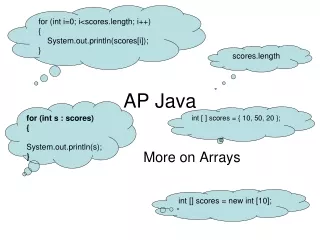
Arrays • One-dimensional • Arrays of primitive types & of objects • Initialization of named arrays: • int[] array = {1, 3, 6, 9};
Control Structures • if • if/else • while • for • return • (do/while, switch, continue, break – not tested)
Method Overloading • Understand signature of method • Depends on number, types & order of parameters • Does not depend on return type of method
Classes • Construct objects with new operator • Supply constructor parameters • Invoke accessor & modifier methods • Modify existing classes • Design own classes
Visibility • All classes will be public • All instance variable will be private • Methods, constructors and constants are either public or private • NO protected
Comments • // single line comments • /* */ block comments • No Javadoc comments
Final & Static • final keyword is used for final block scope constants • static final class scope constants • static methods • static final variables • NO – final parameters, final methods, final classes, static variables
null & this • null reference is in the Java subset • this is restricted to passing an implicit parameter in its entirety to another method (obj.method(this)) • Descriptions such as “the implicit parameter this”
Super • Use to invoke superclass constructor • ex: super(args); • Or to invoke superclass method • ex: super.method(args);
Constructors • Be able to implement • Initialize all instance variables • Don’t need to know default rules
Extend & Implement • extend classes • implement interfaces • Know inheritance!!!
Read and Understand • Be able to read definitions of interfaces and abstract classes • Understand that the abstract methods need to be redefined for non-abstract classes • Write interfaces or class declarations when given a general description of the interface or class
Equals • Know when to use == or .equals • Objects: equals • Identity: ==
Subclass to Superclass • No casting is needed to convert from a subclass to a superclass • Do need to know class casts: • ArrayList xx = new ArrayList(); • yy = (yyclass)xx.get(i);
Packages • import statement • import package.subpackage.class;
Exceptions • NullPointerException • ArrayIndexOutOfBoundsException • ArithmeticException • ClassCastException • IllegalArgumentException
Standard Library Methods • java.lang.Object • equals • toString • java.lang.Comparable • compareTo • java.lang.Integer • Integer(int value) //constructor • intValue • equals • toString • compareTo
Standard Library Methods (cont’d) • java.lang.Double • Double(double value) //constructor • doubleValue • equals • toString • compareTo • java.lang.String • compareTo • equals • length • substring • indexOf
Standard Library Methods (cont’d) • java.lang.Math • abs (for int and double) • pow • sqrt • java.util.Random • nextInt • nextDouble
Standard Library Methods (cont’d) • java.util.ArrayList • size • add • get • set • remove
Two-dimensional Arrays • Ragged arrays are not tested • int [][] x = new int[3][]; • Don’t need to know int[3][3] is an array of arrays • Know that x[0].length is the number of columns in a rectangular two-dimensional array named x
Abstract Classes • AB students are expected to design own interfaces and abstract classes
Throwing Unchecked Exceptions • IllegalStateException • NoSuchElementException
Standard Library Methods • java.lang.Object • equals • toString • hashCode • java.lang.Comparable • compareTo • java.lang.Integer • Integer(int value) //constructor • intValue • equals • toString • compareTo
Standard Library Methods (cont’d) • java.lang.Double • Double(double value) //constructor • doubleValue • equals • toString • compareTo • java.lang.String • compareTo • equals • length • substring • indexOf
Standard Library Methods (cont’d) • java.lang.Math • abs (for int and double) • pow • sqrt • java.util.Random • nextInt • nextDouble
Standard Library Methods (cont’d) • java.util.List • add • size • get • set • iterator • listIterator • java.util.ArrayList • All List methods • add • remove
Standard Library Methods (cont’d) • java.util.LinkedList • addFirst • addLast • getFirst • getLast • removeFirst • removeLast
Standard Library Methods (cont’d) • java.util.Set • add • contains • remove • size • iterator • java.util.HashSet • java.util.TreeSet
Standard Library Methods (cont’d) • java.util.Map • put • get • remove • containsKey • size • keySet • java.util.HashMap • java.util.TreeMap
Standard Library Methods (cont’d) • java.util.Iterator • hasNext • next • remove • Java.util.ListIterator • add • set
Online resources • Acorn online • Java API