Enhancing InGaN-GaN MQW Structures via Temperature Cycling for Improved LED Performance
This study investigates the efficacy of a temperature cycling method in growing InGaN–GaN multiple quantum wells (MQWs) to enhance crystal quality without halting growth. Traditional temperature ramping methods, while effective, risk diminishing crystal quality due to interruptions that can lead to In atom out-diffusion or desorption. Our experiments utilized different temperature profiles during the growth of a 5-period MQW structure, showing significant improvements in both structural integrity and performance of nitride-based LEDs.

Enhancing InGaN-GaN MQW Structures via Temperature Cycling for Improved LED Performance
E N D
Presentation Transcript
Previously, it has been shown that one can use the temperature ramping method (i.e., to grow the InGaN well layers and GaN barrier layers at different temperatures) to improve crystal quality of InGaN–GaN MQW. • However, the proposed methods were required to stop the growth for a short period of time; an interruption during the growth of InGaN–GaN MQW might contribute to the out-diffusion and/or desorption of In atoms. • In this letter, we report the use of the temperature cycling method to further improve the quality of the MQW structure and the performance of nitride-based LEDs.
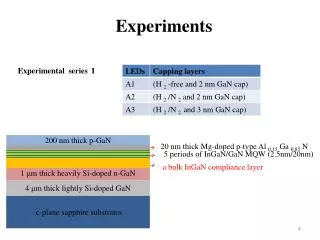
Experiments 1050 ℃ 0.2um Mg-dopedGaN InGaN well : 3nm GaN barrier :15nm five periods MQWs 1050 ℃ 2um Si-doped n-GaN 1um undopedGaN layer 1050 ℃ 520 ℃ 30nm GaN nucleation layer c-plane Sapphire
Results and Discussion Fig. 1. Three different temperature profiles used to grow the MQW active regions in this study.