Cognitive Development Vygotsky’s Approach
120 likes | 1.01k Views
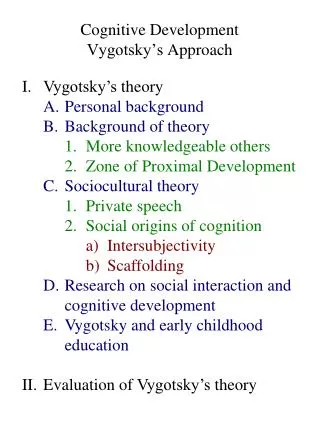
Cognitive Development Vygotsky’s Approach. Vygotsky’s theory Personal background Background of theory More knowledgeable others Zone of Proximal Development Sociocultural theory Private speech Social origins of cognition Intersubjectivity Scaffolding


Cognitive Development Vygotsky’s Approach
E N D
Presentation Transcript
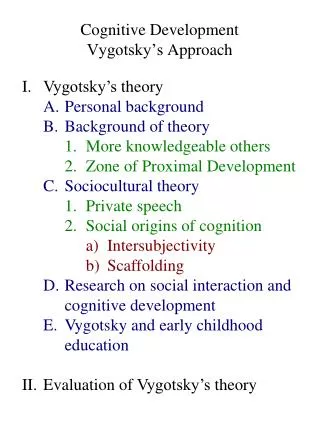
Cognitive DevelopmentVygotsky’s Approach • Vygotsky’s theory • Personal background • Background of theory • More knowledgeable others • Zone of Proximal Development • Sociocultural theory • Private speech • Social origins of cognition • Intersubjectivity • Scaffolding • Research on social interaction and cognitive development • Vygotsky and early childhood education • Evaluation of Vygotsky’s theory
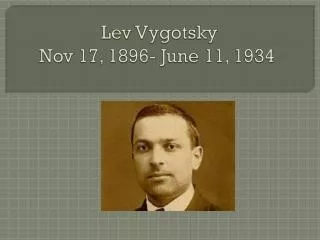
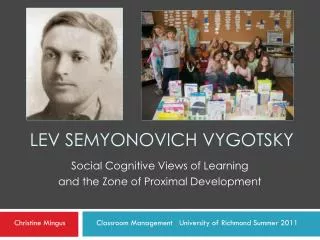
Background of Vygotsky’s theory • Lev Vygotsky • More knowledgeable other • Anyone with better understanding of higher ability • Zone of Proximal Development • Distance between the child’s ability to perform a task with and without help
Sociocultural Theory • Private speech • Piaget’s concept of “egocentric speech” • Vygotsky’s notion of self-directed speech an inner speech • The social origins of cognition • Intersubjectivity • Scaffolding and guided participation
Vygotsky and Early Childhood Education • Importance of active participation • Assisted discovery • Make-believe play • Intersubjectivity • Scaffolding and guided participation
Evaluation of Vygotsky’s Theory • Challenges to Vygotsky: • Limitations to verbal communication • Parent’s versus child’s responsibility in acquiring skills • Role of basic perceptual, motor, attention, memory, problem solving skills