Addressing Climate Change Impacts in Southern Africa: Challenges and Solutions
This document outlines the significant impacts of climate change in Southern Africa, highlighting key development challenges from 2008 to 2013. It discusses sustainable food production, urban and rural population dynamics, and the increased frequency of pest outbreaks affecting trade. The provision of quality water, air quality deterioration, and contributions to sea level rise from thermal expansion and glacial retreat are covered. The role of education in addressing these issues emphasizes multidisciplinary approaches and collaboration between institutions to drive effective adaptation and mitigation strategies.

Addressing Climate Change Impacts in Southern Africa: Challenges and Solutions
E N D
Presentation Transcript
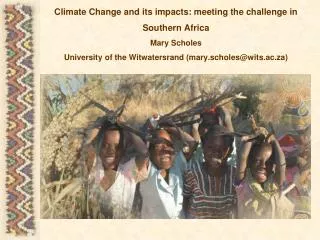
Climate Change and its impacts: meeting the challenge in Southern AfricaMary Scholes University of the Witwatersrand (mary.scholes@wits.ac.za)
Key Development Challenges (2008-2013) Sustainable food production with the lowest carbon/energy footprint. Policy driven population occupation of urban and rural spaces (intact and transformed ecosystems) Increased frequency of outbreaks of pests and pathogens impacting global trade. Provision of good quality water at a regional scale. Deteriorating atmospheric air quality. WHAT IS THE ROLE OF EDUCATION ?
Contributions to sea level rise For 1961-2003: 1.6 mm/yr: (Source: Domingues et al., Nature 2008) • Thermal expansion (ca. 40 %) • Glaciers and ice caps (ca. 35 %) • Continental ice sheets (ca. 25 %) For 2003-2008: 2.5 mm/yr: (Source: Cazenave et al., GPC 2008) • Thermal expansion (ca. 20%) • Glaciers and ice caps (ca. 40 %) • Continental ice sheets (ca. 40 %) Source: S. Rahmstorf
Decline in the Efficiency of the Ocean Sink Credit: N.Metzl, August 2000, oceanographic cruise OISO-5 Primary cause is a 30% decrease in efficiency of Southern Ocean sink. This is probably due to stronger winds around Antarctica, which enhances ventilation of carbon-rich deep waters. Stronger winds are due to climate change and the ozone hole. Relative sink strength, in fraction of emissions Le Quéréet al. 2007, Science: Global Carbon Project
Glacier retreat Kilimanjaro Modelled results, Confirmed by early travellers reports (Fritz 1912) 1912 2000
Southern Africa: Facts (next 50-100 years) • Increases in temperature (1.5 - 3.7°C) • Rainfall (up to 15% in NE; down by 15% in Central to West) • Seasonal rainfall distribution – less winter rainfall • Decreases in water quality and increases in water runoff • Sea level rise (0.5 – 1.5 m) • Increases in extreme events • Increases in disease, especially malaria • Threats to biodiversity hotspots
Regional synthesis • Suggests link btw ecosystem service degradation & declining well-being • Likely to be two-directional pathway
Empirical warming experiments (daily mean ~3oC, max ~6oC)
Conophytum sp Warmed, (4 months, summer) Control
Key Messages from the Copenhagen Congress 1. Climatic trends - urgency 2. Social disruption - defining dangerous climate change 3. Long-term strategy - targets and trajectories 4. Equity dimensions - climate change is unfair 5. Inaction is inexcusable - tools and approaches 6. Meeting the challenge - societal transformation (JSE example)
Mitigation and Adaptation • About 0.6 - 1°C is unavoidable • Mitigation – reduce the emissions, in SA this is very difficult • Adaptation – will be the way • Will time allow? Poor understanding of the limits and the extent of the vulnerability
Role of education • Much stronger emphasis on multidisciplinary degrees especially across the humanities, science and engineering. • Participatory research involving the poor and industries • Much stronger tertiary institutional collaboration with shared courses • Opportunities for the employment of all postgraduate students across the sectors