Download
1 / 6
Download Presentation 
Understanding Constitutional Amendments: Proposal and Ratification Processes
An Image/Link below is provided (as is) to download presentation
Download Policy: Content on the Website is provided to you AS IS for your information and personal use and may not be sold / licensed / shared on other websites without getting consent from its author.
Content is provided to you AS IS for your information and personal use only.
Download presentation by click this link.
While downloading, if for some reason you are not able to download a presentation, the publisher may have deleted the file from their server.
During download, if you can't get a presentation, the file might be deleted by the publisher.
E N D
Presentation Transcript
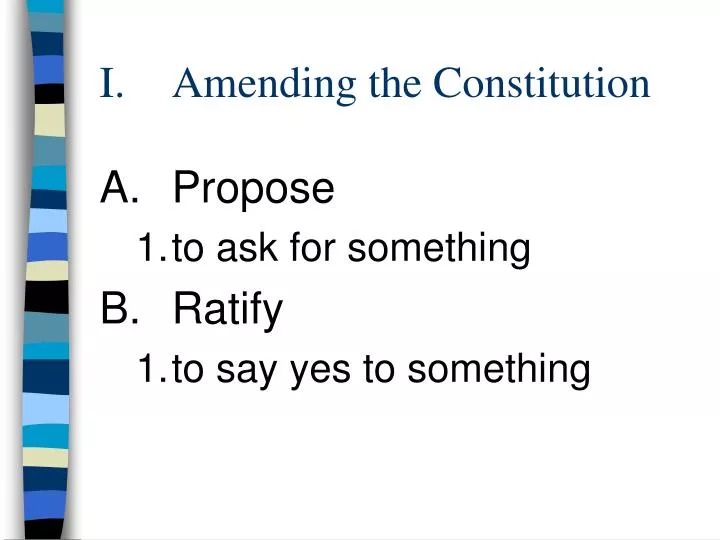
I. Amending the Constitution A. Propose 1. to ask for something B. Ratify 1. to say yes to something
I. Amending the Constitution C. Two ways to propose an Amendment 1. 2/3rd vote of both House and Senate or 2. National Convention a) Called by 2/3rd of the State Legislatures
I. Amending the Constitution D. Two ways to ratify an Amendment 1. 3/4th of the State legislatures 2. 3/4th of the States hold ratifying conventions
I. Amending the Constitution E. Very difficult process 1. WHY?
II. Unofficial amendments A. Necessary and Proper 1. Congress can do whatever it needs to carry out its duties 2. implied powers
II. Unofficial amendments B. Judicial Review 1. Supreme Court tells us what laws mean

More Related