Download
1 / 8
80 likes | 197 Views
The issue of slavery in the Western territories significantly heightened tensions between the North and South in America before the Civil War. The contrasting economies—industrial North versus rural South—led to differing perspectives on slavery. The critical debates surrounding the Wilmot Proviso, California's statehood, and the Compromise of 1850 showcased the deep divisions. Northerners favored banning slavery in new territories, while Southerners viewed this as a threat to their way of life, ultimately leading to discussions of secession and contributing to the impending conflict. ###

E N D
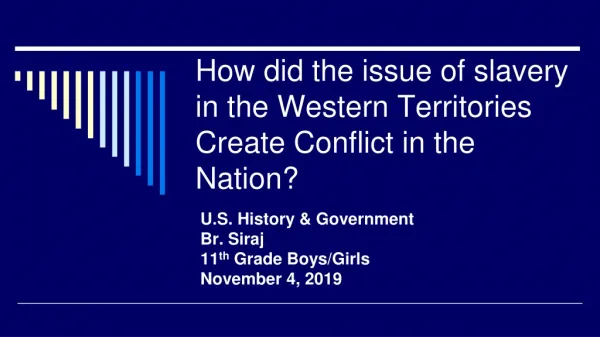
How did the issue of slavery in the Western Territories Create Conflict in the Nation? U.S. History & Government Br. Siraj 11th Grade Boys/Girls November 4, 2019
What were the Differences Between the North & the South? • The North was Industrial • 20000 miles of railroads • Factories and cities • New immigrants opposed to slavery • The South Remained Agricultural • Rural and few industries • Few immigrants
Differences Over Slavery • Debate over Wilmot Proviso • A bill that would ban slavery in any new territory acquired from Mexico • Northerners favored the bill • Southerners opposed the bill, because it violated their constitutional rights • 1849 California asked to join the Union as a free state • Southerners wanted it to be slave state because of Missouri Compromise
California Issue • President Zachary Taylor Supported California because he believed: • California’s climate and terrain is not suitable for slavery • South be better off leaving the slavery issue up to individual territories rather than Congress • Southerners took this as an attack on their way of life & seriously started to think about leaving the union.
Congressional Debate • 31st Congress opened with an atmosphere of distrust and bitterness. • California became a big issue • Northerners demanded the end of slavery in the D.C. • Southerners wanted northerner to strictly enforce Fugitive Slave Act 1793 • Some southern states threatened secession.
The Compromise of 1850 • Henry Clay presented a compromise – Compromise of 1850. • California be admitted as a free state • Stricter fugitive slave law – northerners to return fugitive slaves • Popular Sovereignty to be used to determine the slavery issue in the territories • Federal Government to pay Texas $10 million to give up claim on New Mexico.
The Compromise of 1850 • Daniel Webster of Massachusetts supported the plan • John C. Calhoun of South Carolina opposed the compromise • Congress failed to pass the compromise • Senator Stephen Douglas of Illinois then got it passed by presenting each section as a separate bill. • It didn’t settle the issue of slavery for long
Homework • Questions 1, 2 & 3 on page 309