Understanding Agreement and Question Formation Across Different Languages
150 likes | 287 Views
This guide explores the concepts of agreement and question formation in various languages, focusing on verb, noun, adjective, and determiner agreements. It examines case marking systems, such as nominative-accusative and ergative-absolutive, with examples from Italian, Swahili, and Spanish. You will learn how to form yes/no questions and content questions effectively, along with the necessary changes in word order or intonation. This resource is essential for language learners and educators looking to enhance their understanding of grammatical structures.


Understanding Agreement and Question Formation Across Different Languages
E N D
Presentation Transcript
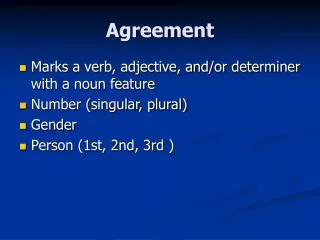
Agreement • Marks a verb, adjective, and/or determiner with a noun feature • Number (singular, plural) • Gender • Person (1st, 2nd, 3rd )
Verb agreement Italian Lei parla italiano She speaks Italian Lei parl-a italiano 3Fem.sg. speak-3sg Italian
Verb agreement • Swahili Juma aliwapiga watoto Juma hit children Jumaa-li-wa-piga watoto Juma he-past-them-hit children
Adjective and determiner agreement • Spanish La mujer rica ‘the rich woman’ La mujer ric-a DET.fem.sg. woman rich-fem.sg Los edificios altos ‘the tall buildings’ L-osedificio-s alt-o-s DET-masc.pl building-pl tall-masc-pl os
Case • Marks a noun phrase or pronoun • Information about function of noun phrase in a sentence
Two systems 1. Nominative-Accusative case marking Subject of intransitive verb (sit, walk, ...) NOM Subject of transitive verb (hit, see... ) NOM Object of transitive verb ACC 2. Ergative-Absolutive case marking Subject of intransitive verb ABS Subject of transitive verb ERG Direct object of transitive verb ABS
Nominative-Accusative • Intransitive verb John-ga naita John-NOM cried John cried • Transitive verb Mary-ga John-o mita Mary-NOM John-ACC saw Mary saw John
Ergative-Absolutive • Intransitive verb Na’e alu ‘a Tevita went ABS David David went • Transitive verb Na’e ma’u ‘e Tevita‘a e me’a’ofa received ERG DavidABS the gift David received the gift
Questions • How do you say questions in your language? • Yes/No Questions • Content Questions
Yes-No Questions • You want to know if John bought new pants 1. Intonation: John bought new pants? 2. Change word order English Did John buy new pants?
Yes-No Questions 3. Use a Question word Mandarin Statement John mai ifu John buy clothes Question John mai ifu ma? John buy clothes QW ‘Did John buy new clothes?’
Content Questions • Who, what, how, where, etc.
Content Questions 1. QW in same place as missing info Mandarin Statement: Ni kan Lisi You see Lisi Question: Ni kan shei? You see who?
Content Questions 2. QW at beginning (=change word order) English Statement: John sees Lisa Question: Whom does John see?
Content Questions 3. QW at beginning or same place French: Statement Il voit son amie He see his friend Question Qui voit il? who sees he Question Il voit qui? he sees who