Investigating Dark Matter and MOND through Globular Cluster Observations
50 likes | 155 Views
This project aims to observe nearby and distant globular clusters (GCs) to understand their structure, measure their velocity dispersions, and determine their dark matter (DM) content. The study seeks to test Modified Newtonian Dynamics (MOND) in objects devoid of DM as ideal candidates, particularly distant GCs with a acceleration threshold of ~10^-8 cm/s². By comparing the dynamical models of GCs, we aim to provide compelling evidence for or against the existence of DM while also contributing valuable legacy data on black hole masses and orbital parameters.


Investigating Dark Matter and MOND through Globular Cluster Observations
E N D
Presentation Transcript
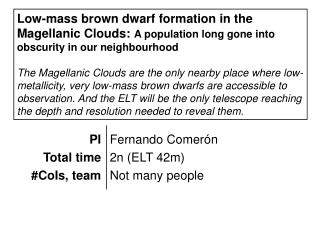
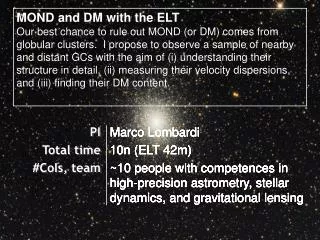
MOND and DM with the ELT Our best chance to rule out MOND (or DM) comes from globular clusters. I propose to observe a sample of nearby and distant GCs with the aim of (i) understanding their structure in detail, (ii) measuring their velocity dispersions, and (iii) finding their DM content. PI Total time #CoIs, team Marco Lombardi 10n (ELT 42m) ~10 people with competences in high-precision astrometry, stellar dynamics, and gravitational lensing Marco Lombardi 10n (ELT 42m) ~10 people with competences in high-precision astrometry, stellar dynamics, and gravitational lensing Marco Lombardi 10n (ELT 42m) ~10 people with competences in high-precision astrometry, stellar dynamics, and gravitational lensing Marco Lombardi 10n (ELT 42m) ~10 people with competences in high-precision astrometry, stellar dynamics, and gravitational lensing Marco Lombardi 10n (ELT 42m) ~10 people with competences in high-precision astrometry, stellar dynamics, and gravitational lensing
MOND and CDM Structure formation still poorly understood freedom in the distribution of DM MOND better verifier in objects w/o DM stronger bounds on Newtonian dynamics Ideal candidates are distant GCs they have a <a0 ~ 10-8 cm s-2 Idea: observe GCs, understand their structure, and see if MOND works.
Newtonian prediction (virial theorem): 2 = G M / rv z2 = 0.11 G M / rh • MOND prediction (regime aext < aint < a0) z2 = 0.22 (a0G M)1/2 • For distant GCs the two predictions differ by a factor ~3 Use LOS velocity dispersion measurements of GCs to distinguish the two cases (Baumgardt et al. 2005)
Proposal • Observe a nearby GC with GAIA + ELT to determine its internal structure and compelling evidence of no DM • Measure the structure and vel. dispersion of a distant GC in the MOND regime • Compare the two cases to find if Newtonian or MOND dynamics hold
ELT Justification: observations require extreme astrometry and measurements of individual velocities in the cores of globular clusters. Legacy Value: the same data will be provide (i) a measurement of BH masses in GCs, (ii) accurate (1%) orbital parameters of GCs, (iii) (µ)lensing data in GCs, and (iv) f(r,v) Data Reduction: combined ELT-GAIA analysis required