Understanding Scalars and Vectors in Physics: Definitions, Examples, and Operations
This resource provides a comprehensive overview of scalar and vector quantities in physics. Scalars are defined as quantities with magnitude only, such as distance, speed, mass, time, and volume, which can be added like regular numbers. In contrast, vectors have both magnitude and direction, exemplified by displacement, velocity, acceleration, and force. The addition of vectors requires special techniques, including graphical methods using arrows. This guide will help you understand how to represent, add, and work with these fundamental concepts in physics.

Understanding Scalars and Vectors in Physics: Definitions, Examples, and Operations
E N D
Presentation Transcript
Physics Quantities Scalars and Vectors
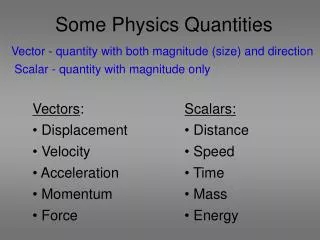
Scalar: • A quantity that is described by magnitude only. • You add scalar quantities like you normally add numbers. • 5 mL of water added to 5 mL of water will give you 10 mL of water. • Some examples of scalars are • Distance • Speed • Mass • Time • Volume.
Vector: • A quantity that is described by stating its magnitude and direction. • You must learn special methods to add vectors (see below). • Some examples of vectors are • Displacement • Velocity • Acceleration • Force.
Vectors (cont.) • Vectors are represented by arrows (directed line segments). • A vector has a head and a tail. • The length of the arrow, when drawn to some self-determined scale, represents the magnitude of the vector and its direction is the way it points in 3-dimensional space as you sight from tail to head. Tail Head
Vectors (cont.) • They can be added graphically by placing the arrows head to tail. • The arrow that extends from the tail of the first vector to the head of the last vector is called the resultant. • It indicates both the magnitude and direction of the vector sum. Vector AVector B Resultant= Vector A + Vector B
Vectors (cont.) • Remember, vectors don't always have to be in a straight line but may be oriented at angles to each other, such as Vector AVector B Resultant= Vector A + Vector B
Vectors (cont.) • Vectors can be added in any order. Vector BVector A Resultant= Vector B + Vector A
Vectors (cont.) Vector AVector B Resultant = Vector A + Vector B
Vectors (cont.) • More than two vectors can be added together using the head-to-tail method. Vector AVector BVector CVector D Resultant = Vector A + Vector B + Vector C + Vector D
Vectors (cont.) Resultant vectors can be determined by a number of different methods. You will solve vector addition exercises both graphically and with vector components.