Dynamic Ethernet Transport with LCAS in Multi-Domain SDH Networks
This scenario explores the capabilities of a multi-domain Synchronous Digital Hierarchy (SDH) transport network enhanced with Linear Protection (LCAS) for efficient Ethernet traffic management. The architecture includes dynamic allocation of virtual channels (VCs) to support both "smart" routers and "dumb" switches. With advanced features such as call bandwidth modification for smart devices and an automatic trigger mechanism for dumb devices, the network achieves higher resilience and efficient interconnection across metro aggregation points. This enables seamless transport of Ethernet signals and interconnection of geographically distributed LANs.

Dynamic Ethernet Transport with LCAS in Multi-Domain SDH Networks
E N D
Presentation Transcript
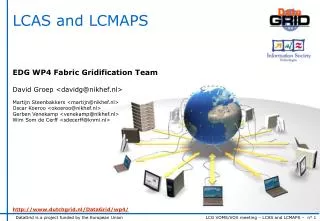
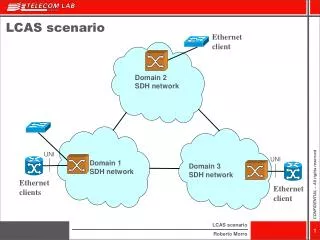
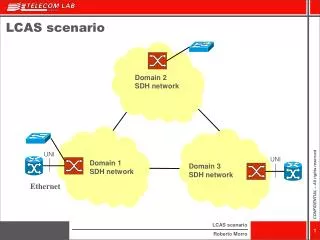
LCAS scenario Domain 2 SDH network UNI UNI Domain 1 SDH network Domain 3 SDH network Ethernet
LCAS scenario • (Multi-domain) SDH transport network with LCAS/VCAT/GFP capabilities (at least in the edge-nodes) supporting ethernet clients both “smart” (i.e. routers) and “dumb” (i.e. switches) • Dynamic allocation of VCs to efficiently transport ethernet traffic (up to 2 VC-3 for fast-ethernet and up to 21 VC-3 for gigabit-ethernet). Different granularities may be used as well. • For “smart” client devices: • UNI with “call bandwidth modification” primitive • For “dumb” client devices: • An automatic trigger mechanism can be implemented on the edge nodes, monitoring the amount of traffic received from the client device • Higher resilience degree can be obtained dividing the VCG on 2 or more diversely routed paths.
Network services • Use of legacy SDH metro (or regional) networks for transport of ethernet signals from the access segment to the metro aggregation POP • Interconnecting of geographically distributed ethernet LANs • Interconnecting metro PoPs via a Core (Long Haul) Network