Download
1 / 7
80 likes | 228 Views
Independent assortment and segregation are key processes in meiosis that contribute to genetic variation. Independent assortment, a principle established by Gregor Mendel, holds that alleles separate independently during gamete formation, allowing for various combinations of traits. Segregation ensures that only one allele from each gene pair is passed into each gamete. Together, these mechanisms enable the formation of four unique sex cells, which fosters genetic diversity in populations, making them essential for evolution and natural selection.

E N D
Independent Assortment and Segregation Describe independent assortment and segregation and explain the relevance of these to variation.
Variation in Meiosis Meiosis provides variation – it produces 4 unique sex cells. The processes WITHIN Meiosis that produce variation are: 1. Independent Assortment 2. Crossing Over 3. Segregation
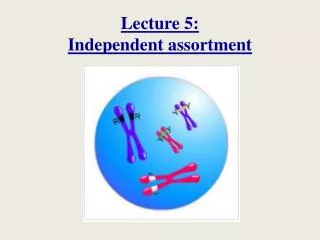
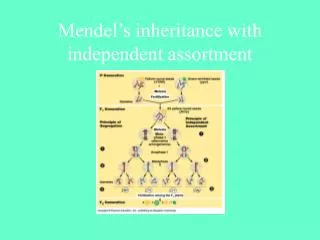
Independent Assortment Independent assortment is a basic principle of genetics developed by a monk named Gregor Mendel in the 1860's This principle states that the alleles for a trait separate when gametes are formed. • Worksheet • Animation • http://www.sumanasinc.com/webcontent/animations/content/independentassortment.html
Segregation • the paired alleles of the genes, which determine the traits of an organism, are segregated (separated) during gamete formation so that only one allele passes into each gamete. • http://www.yteach.co.uk/page.php/resources/view_all?id=allele_diploidy_haploidy_heterozygote_homozygote_homologous_chromosomes_phenotype_genotype_gene_locus_meiosis_dominant_alleles_recesive_alleles_test_cross_page_3&from=search
Segregation occurring • Who can spot the crossing over happening?
WB p90 In your book – answer- • How does Segregation provide variation? • How does Independent Assortment provide variation?