Understanding Kepler's Laws of Planetary Motion and Newton's Contributions
This comprehensive guide delves into Kepler's three laws of planetary motion: the law of ellipses, the law of equal areas, and the law of periods. It explains the concepts of eccentricity and orbital period, highlighting how planetary distance from the Sun affects speed. Additionally, it contrasts Newton's ideas on gravitational forces with Kepler's geometric descriptions, emphasizing the significance of inertia and gravity in determining planetary orbits. This text serves as a valuable resource for students exploring the dynamics of celestial movements.

Understanding Kepler's Laws of Planetary Motion and Newton's Contributions
E N D
Presentation Transcript
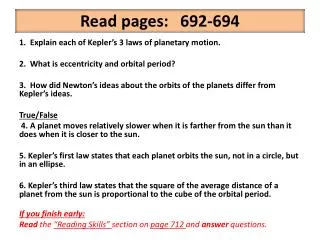
Read pages: 692-694 1. Explain each of Kepler’s3 laws of planetary motion. 2. What is eccentricity and orbital period? 3. How did Newton’s ideas about the orbits of the planets differ from Kepler’sideas. True/False 4. A planet moves relatively slower when it is farther from the sun than it does when it is closer to the sun. 5. Kepler’s first law states that each planet orbits the sun, not in a circle, but in an ellipse. 6. Kepler’s third law states that the square of the average distance of a planet from the sun is proportional to the cube of the orbital period. If you finish early: Read the “Reading Skills” section on page 712 and answerquestions.
Read pages: 692-694 Law of ellipses – each planet orbits the sun in a path called an ellipse Law of equal areas – equal areas are covered in equal amounts of time as an object orbits the sun Law of periods – the cube of the average distance of a planet from the sun is always proportional to the square of the period 1. Explain each of Kepler’s3 laws of planetary motion. scientists use a planet’s orbital period to determine how far away a planet is from the sun
Read pages: 692-694 2. What is eccentricity and orbital period? Eccentricity(unit = e) - the degree of elongation of an elliptical orbit Orbital period – the time required for a body to complete a single orbit
Read pages: 692-694 3. How did Newton’s ideas about the orbits of the planets differ from Kepler’sideas. Kepler described the elliptical shape of planetary orbits and the planets’ speeds at different points along their orbits. Newton gave the causes of these same orbital motions: the curved elliptical orbital motion is the sum of the straight-line motion of a planet that results from inertia and the attractive force of gravity from the sun.
Read pages: 692-694 True/False 4. A planet moves relatively slower when it is farther from the sun than it does when it is closer to the sun. 5. Kepler’s first law states that each planet orbits the sun, not in a circle, but in an ellipse. 6. Kepler’s third law states that the square of the average distance of a planet from the sun is proportional to the cube of the orbital period. True True False
Read pages: 692-694 If you finish early: Read the “Reading Skills” section on page 712 and answerquestions. 8 – C 9 – F 10 – how all the stars move together AND how the whole sky spins slowly as the night goes on