Download

1 / 6
60 likes | 192 Views
Explore finite-state machines (FSMs) with outputs through a practical example of a vending machine. This machine accepts nickels, dimes, and quarters, and provides orange and apple juice based on user input after receiving 30¢ or more. Learn about the components of an FSM, including states, input and output alphabets, initial states, and functions. We present examples of FSMs with outputs, demonstrating concepts like unit-delay machines and binary integer addition, enhancing your grasp of FSM functionality and application.

E N D
Example of a FSM with Output • A vending machine accepts nickels (5¢), dimes (10¢), and quarters (25¢). When 30¢ or more has been deposited, the machine returns the amount over 30¢. The customer can then press an O-button to receive orange juice or an R-button to receive apple juice
Example of a FSM with Output • The same FSM can be represented using a table
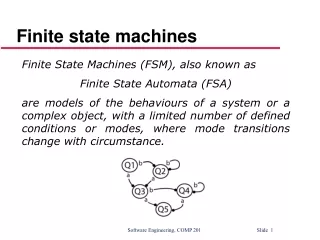
FSMs with Outputs • A finite-state machine M = (S, I, O, f, g, s0) consists of: • a finite set S of states • a finite input alphabet I • a finite output alphabet O • an initial state s0 • a transition function f • an output function g • Example 1: • S = {s0, s1, s2, s3} • I = {0, 1} • O = {0, 1} • Initial: s0 • f, g: state table/diagram
FSMs with Outputs • Example2: unit-delay machine • given the bit string x1x2…xk it produces 0x1x2…xk-1
FSMs with Outputs • Example3: adding machine for binary integers • given (xn…x1x0)2 and (yn…y1y0)2 it produces their sum