Active Reading Strategies: Steps for Enhanced Comprehension and Engagement
Active Reading is a structured process that enhances comprehension by breaking it down into manageable steps. It addresses gaps in attention, memory, and language skills by guiding students through a sequence of strategies: Preread, Read & Highlight, Paraphrase & Margin Note, Chunk, and Summarize. Each step prepares students for understanding the text, encourages active participation, and improves retention. By integrating their reading with writing about texts, students can develop a deeper comprehension. This approach recognizes that many college students enter with inadequate skills and aims to equip them effectively.

Active Reading Strategies: Steps for Enhanced Comprehension and Engagement
E N D
Presentation Transcript
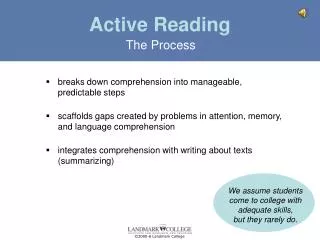
Active Reading The Process • breaks down comprehension into manageable, predictable steps • scaffolds gaps created by problems in attention, memory, and language comprehension • integrates comprehension with writing about texts (summarizing) We assume students come to college with adequate skills, but they rarely do.
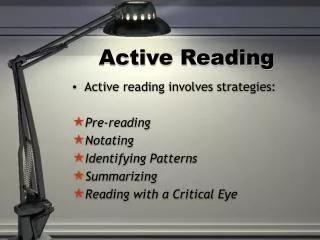
Active Reading Steps • Preread • Read & Highlight • Paraphrase & Margin Note • Chunk • Summarize
Active Reading Step Preread • The title • The chapter outline • The intro and/or first paragraph • The end of chapter aids • Heading and subheadings • The first sentence of the first paragraph after each heading and subheading • Preread • Read & Highlight • Paraphrase & Margin Note • Chunk • Summarize
Active Reading Step Preread • Benefits: • Prepares reader for what’s ahead. • Activates readers background knowledge. • Helps predict content of the text. • Establishes purpose. • Emphasizes the ‘text’. • Strategies: • Study the pictorial aids. • Notice important terminology. • Label major headings with Roman numerals, subheadings with capital letters. • Highlight while previewing and reading. • Preread • Read & Highlight • Paraphrase & Margin Note • Chunk • Summarize
Active Reading Step Read & Highlight • Benefits: • Forces you to sift and sort ideas • Keeps you physically active, focuses concentration. • Strategies: • Read first, then highlight. • Use a highlighter to answer the questions. • Use a consistent system of 3 colors – main ideas, details, and vocabulary • Keep the 20% rule (don’t over or under highlight). • Preread • Read & Highlight • Paraphrase & Margin Note • Chunk • Summarize
Active Reading Step Paraphrase & Margin Note • Benefits: • Forces students to rephrase information into their own words. • A form of elaborate rehearsal to improve retention. • Strategies: • Paraphrase the Main Idea: in the margin, on separate paper, on a sticky note. • Mark the text: adds another layer of activity to reading, uses words, symbols, and comments. • Locate key words or phrases. • Find accurate synonyms for key words and replace. • Change the word order. • Check that meaning has not changed. • Locate the Main Idea and 3 supporting details. • Preread • Read & Highlight • Paraphrase & Margin Note • Chunk • Summarize
Active Reading Step Chunk • Benefits: • Follows a writer’s train of thought. • Build’s on margin noting skills. • Makes readers aware of text organization • Forms the skeleton of a summary. • Strategies: • Margin note the first paragraph. • As you read, decide whether the idea continues to expand or shifts to a new thought. • Label the chunk. • Preread • Read & Highlight • Paraphrase & Margin Note • Chunk • Summarize
Active Reading Steps Chunking Example:
Active Reading Step Summarize • Benefits: • Restates and condenses meaning of text • Allows readers to process main ideas to see a bigger picture. • Bullet one • Bullet two • Bullet three • Bullet four • Bullet five • Strategies: • Organize information in a summary form: written paragraph, outline, or visual map. • Preread • Read & Highlight • Paraphrase & Margin Note • Chunk • Summarize
Textbook Skills Most texts provide supplementary aids. However, many students do not know how to use them. Teach effective use of: • Chapter outlines • Introductions • Graphic information • Summaries • Questions • Index • Glossaries .
SQ3R (survey, question, read, recite, and review) A tried and true textbook reading strategy. Developed in 1941 and tested heavily. Value: integrates study and review with reading. First example of a multi-pass approach to active reading.
Active Reading… • Gives students the tools to monitor their reading comprehension • Allows students to take an active role in their learning process • Provides a structure within which students can reflect on and question the content of their reading