Dry Boundary Layer Dynamics
This paper explores the dynamics of the dry boundary layer through an idealized theoretical lens, extracting key insights from Emanuel and Mike Pritchard’s work. It highlights the fundamental aspects of Rayleigh-Bénard convection, reviewing similarity theory and its applications to thermally and mechanically driven flows. Critical parameters, such as the Rayleigh number, and their implications for lab-based models are discussed, revealing the limitations of current laboratory results in understanding real atmospheric conditions. The significance of the Monin-Obukov length scale in characterizing boundary layer behavior is emphasized, along with future research directions involving moisture effects.

Dry Boundary Layer Dynamics
E N D
Presentation Transcript
Dry Boundary Layer Dynamics Idealized theory Shamelessly ripped from Emanuel Mike Pritchard
Outline • Highlights of Rayleigh-Bernard convection • Similarity theory review (2.1) • Application to semi-infinite idealized dry boundary • Uniformly thermally (buoyancy) driven only • Mechanically (momentum) driven only • Thermally + Mechanically driven • The “Monin-Obunkov” length scale • Characteristics of a more realistic typical dry atmospheric boundary layer
Rayleigh vs. Reynolds number • Laminar case • Re = Ra / • Turbulent case • Re2 = (Fr)(Ra) /
The Rayleigh-Bernard problem • Parallel-plate convection in the lab • Governing non-dimensional parameter is • Linear stability analysis • Critical Rayleigh number yields convection onset • Steady rolls/polygons • Horizontal scale ~ distance between plates
The Rayleigh-Bernard problem • Linear theory succeeds near onset regime • Predicts aspect ratio and critical Rayleigh number • Further analysis requires lab-work or nonlinear techniques
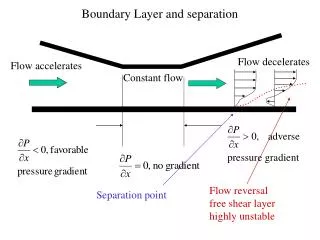
Lessons & Limitations • Potential for convective regime shifts & nonlinear transitions. • Atmosphere is Ra ~ 1017-1020 • Lab results only go so far • Appropriate surface BC for idealized ABL theory is constant flux (not constant temperature)
Similarity theory • Applicable to steady flows only, can’t know in advance if it will work. • Posit n governing dimensional parameters on physical grounds • Flow can be described by n-k nondimensional parameters made out of the dimensional ones • Allows powerful conclusions to be drawn (for some idealized cases)
Thermally driven setup Volume-integrated buoyancy sink Q Statistical steady state… w’B’ Buoyancy flux What can dimensionalanalysis tell us? T = T0
Mechanically driven setup Volume-integrated momentum sink M Statistical steady state… w’u’ Convective momentum flux (J/s/m2) What can dimensionalanalysis tell us? T = T0
Joint setup Volume-integrated momentum sink Volume-integrated buoyancy sink M Q w’u’ w’B’ Momentum flux Buoyancy flux T = T0
Hybrid idealized model resultsafter asymptotic matching… Theory: Obs:
Summary of theoretical results • Thermally driven • Convective velocity scales as z1/3 • Mechanically driven • Convective velocity independent of height • Hybrid • Mechanical regime overlying convective regime • Separated at Monin-Obunkov length-scale • Matched solution is close but not a perfect match to the real world
Things that were left out of this model • Mean wind • Depth-limitation of convecting layer • Due to static stability of free atmosphere • Height-dependent sources and sinks of buoyancy and momentum • Rotation • Non-equilibrium • E.g. coastal areas
Typical observed properties of a dry convecting boundary layer
The Entrainment Zone • Temperature inversion; boundary between convective layer and “free atmosphere” • Monin-Obukov similarity relations break down • Buoyancy flux changes sign • Forced entrainment of free-atmosphere air • I.e. boundary layer deepens unless balanced by large-scale subsidence
Next week….? • Adding moisture to equilibrium BL theory • Ch. 13.2 • Adding phase changes • Stratocumulus-topped mixed layer models • Ch 13.3