Download
1 / 11
110 likes | 239 Views
Master the art of professional email communication with essential tips for maintaining professionalism in your correspondence. Learn the importance of using an appropriate email address, crafting subject lines, and employing correct grammar. This guide emphasizes the necessity of salutations, thorough proofreading, and the significance of keeping your emails formal. With actionable advice to ensure your emails reflect your professional persona, you’ll be prepared to communicate effectively in any workplace setting.

E N D
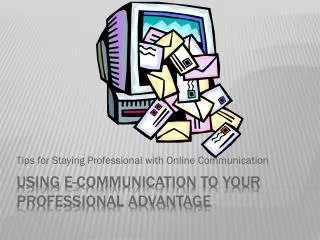
Tips for Staying Professional with Online Communication Using E-Communication to your Professional Advantage
E-Mail • E-mail is very important to employers • It is part of a company’spermanent record • Employees are expected to follow the rules of Standard Written English • Always send professional e-mails no matter who the audience
Tips for Writing E-Mails • Always have an appropriate e-mail address • Appropriate e-mails include: • ssmith@email.com • S_smith@email.com • SallySmith@email.com • Sally_Smith@email.com • ssmith1@email.com
Tips for Writing E-Mails • Do not use any silly e-mail addresses • Inappropriate e-mails include: • SamluvsJohn@email.com • partygirl@email.com • ilovebeer@email.com • boycrazy42@email.com
Tips for Writing E-mails • Always type something in the subject line • Appropriate references for the subject line include: • Staff Meeting Agenda • Request for Appointment • English 102 Take Home Exam • Sally Smith Resume
Tips for Writing E-mails • It is important to avoid informal subject lines • Examples of inappropriate subject lines include: • Hey • Question • What’s up • Confused • Help
Tips for Writing E-mails • Use regular capitalization and complete sentences • Do: • I am writing this letter in reference to John Smith. • Don’t: • this letter is re: john smith • Always use complete sentences, correct punctuation, and correct capitalization
Tips for Writing E-mails • Include a salutation • Examples: • Dear Mr. Smith • Dear Dr. Thompson • Dear Ms. Allen • It is extremely important to include a salutation whenever writing an e-mail, no matter who you are writing to
Tips for Writing E-mails • Proofread every e-mail • Proofread for even the smallest mistakes • Taking the time to proofread your e-mail helps eliminate any unnecessary errors • Always spell-check your e-mails before sending
Tips for Writing E-mails • Always “sign” your name • Do: • Sincerely, Sally Smith • Best Regards, Sally Smith • Thank you, Sally Smith • Don’t: • Later • Seya (see ya) • Peace • Never end an e-mail without “signing” your name
Tips for Writing E-mails • Remember, an e-mail can be forwarded to anyone without your knowledge • Once you send it, you have no control over it • Make sure there is nothing in the e-mail that you might regret having writtenlater on