Download
1 / 4
40 likes | 147 Views
This study explores how early life behaviors in female-assigned males and CAH females may predict adult gender identity. Key observations include a tendency for rough-and-tumble play, preference for male playmates, and male-typical cognitive skills. The research highlights the significant role of both social interactions and prenatal hormone exposure in shaping gendered behaviors. Notably, it finds that a percentage of CAH females and male-assigned individuals remain content with their gender assignment. Future questions address the impact of hormone levels and social rank on gender-typical behaviors.

E N D
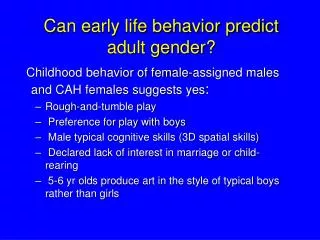
Can early life behavior predict adult gender? Childhood behavior of female-assigned males and CAH females suggests yes: • Rough-and-tumble play • Preference for play with boys • Male typical cognitive skills (3D spatial skills) • Declared lack of interest in marriage or child- rearing • 5-6 yr olds produce art in the style of typical boys rather than girls
Is there a role for social interactions to influence adult gendered behavior? • 50% of CAH females and 36% of males assigned as females remain content with assignment • Social environment interacts with prenatal hormone environment of rhesus macaques to predict juvenile and adult sexually-dimorphic behavior Wallen. Horm Behav, 1996, 30:364-378 Tomaszycki, et al. Horm Behav, 2001, 39:267-276
Hypothesis • Early behavior will reliably predict adult behaviors related to gender identity (i.e., sexually dimorphic behaviors in animal models) • Social interactions will interact with prenatal hormone exposure to influence adult behaviors.
Questions for the Future • Do early social interactions (e.g., rank differences) in females correlate with variation in amount of expressed male behavior? • Is it Androgen or Estrogen that is critical influence on behavior? • What role do postnatal, pubertal hormones play? • How are the brains being altered?