Download

1 / 18
180 likes | 277 Views
This deliverable from November 9, 2010, by Team #3 outlines the interim design process for integrating an electric ducted fan (EDF) into a Micro Air Vehicle (MAV). The document covers EDF vs. propeller comparisons, final component selection, Lean Six Sigma methodology updates, calculated values, designs, center of gravity analysis, cost and weight analysis, conclusion, and future work plans. The focus is on optimal fuselage and air flow design within set constraints. Various references and calculations are included for comprehensive insights.

E N D
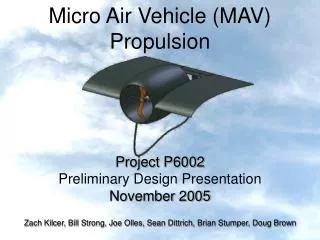
Integration of experimental propulsion systems in micro air vehicles Deliverable: Interim Design November 9, 2010 Team # 3 Erica Cosmutto Hunter Metzger Joel Ware Kristina De Armas Michael Isaza Santiago Baus
OverView • Introduction • EDF vs Propeller • Final Component Selection • IE Update • Calculated Values • Designs • Center of Gravity • Cost and Weight Analysis • Conclusion • Future Work
Introduction • Integrate an electric ducted fan into the fuselage of a Micro Air Vehicle (MAV) • Focus on: • Fuselage design • Air Flow Inlet/Duct design • Integrating electronics and fan into the fuselage • Constraints: • 10 lb max • 6 in diameter • 32 in length
EDF VS Propeller fan • Duct reduces losses in thrust caused by tip vortices • The Ducted fan operated at higher velocity • EDF has a smaller diameter • EDFs are quieter and safer
Final Component Selection 76mm ID, 80mm OD 22.2V 391g 55A $129.50 TP8000-6S4PL 22.2V 8000mAh 16C $509.99 Smart Guide ESC Up to 44.4V 100A $120.00
IE Update • Lean Six Sigma Methodology • DMAIC process • Define Phase Complete • Measure Phase due November 30th • Define performance standards • Establish data collection plan • Validate the measurement system • Collect necessary data from existing system
Values Calculated • Maximum Thrust of 2.2 kg =21.6 N • Ideal Inlet Area= 5.643 in2 (FSA, Fan Sweep Area) • Ideal Exit Area=4.3 in2 (75% of FSA) • Maximum Velocity Exiting Fan=52.478 m/s
Design 1 • Design specified by sponsor • Intake from the bottom of the MAV
Design 2 • Intake on top and bottom • Laminar flow off top surface
Design 3 • Maximize flow intake • Simple design
Design 4 • Uses two side ducts • Smooth intake of air
Center of Gravity 1.92 in Desired CG Current CG ESC 110g Fan 391g Battery 932g Fuselage 3084g
Conclusion • Four fuselage designs • Initial Calculations and Analysis • Calculated Ideal Inlet and Outlet Areas • Center of Gravity Analysis • Final Component Selection • The team has started work at HPMI
Future Work • Continue work at HPMI • Produce the first mold • Receive Components • Testing in Comsol and wind tunnels • Measurement of Existing Model
References • Hobbypartz.com • Thunderpowerrc.com • Hobbytown.com • “The Calculation and Design of Ducted Fans”.Wattflyer.com • www2.nlr.nl/public/facilities/AVET-Info/Content/UK/PropBlades.html • www.sterndrive.info/400_800_cobra_propellers.html