Download
1 / 15
160 likes | 282 Views
This lesson explores the fundamental concepts of geometry, focusing on segments, rays, lines, and planes. A line segment consists of two endpoints with all points in between, while a ray has one endpoint and extends infinitely in one direction. Learn about opposite rays, which are collinear rays sharing an endpoint, and how they form a line. Discover different types of lines, including intersecting, parallel, and skew lines, each with unique properties in relation to planes. Engage with practice exercises to identify these geometric elements in diagrams.

E N D
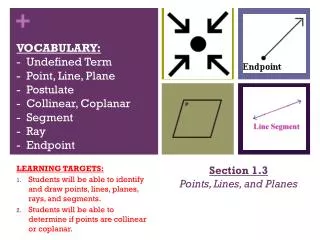
Parts of Lines Segment The part of a line consisting of two endpoints and all the points in between
Parts of Lines Ray The part of the line consisting of one endpoint and all the points of the line on one side of the endpoint
Parts of Lines Opposite Rays Two collinear rays with the same endpoint Opposite rays always form a line!
Practice Name the segments Name the rays Name a pair of opposite rays
Types of Lines Intersecting Same plane? Intersect?
Types of Lines Parallel Same plane? Intersect?
Types of Lines Skew Same plane? Intersect?
Types of Lines Skew lines are hard to see. Activity Time!
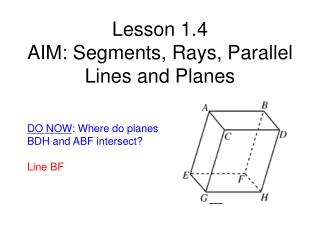
Example Name all segments that intersect Name all segments that are parallel to Name all segments that are skew to
Parallel Planes Parallel planes are planes that do not intersect. Name a plane that is parallel to plane ABCD. Name another pair of parallel planes.
Practice • Are and in the same plane? 2. Name all the segments parallel to .
Practice • Name all segments skew to 4. Draw on the diagram.
Practice Mark a point I on the diagram so that and are opposite rays.
Exit Homework