Download
1 / 3
30 likes | 156 Views
This document explores the principles of momentum, defined as the product of mass and velocity (p = mv), emphasizing its vector nature, where direction is crucial. It delves into impulse, the change in momentum due to net force (J = FDt), and distinguishes between elastic and inelastic collisions. In elastic collisions, objects bounce off without lasting deformation or energy loss, while inelastic collisions involve lasting deformation, resulting in energy loss as heat. Notably, momentum is conserved in all collisions, leading to the principle of momentum before and after any impact.

E N D
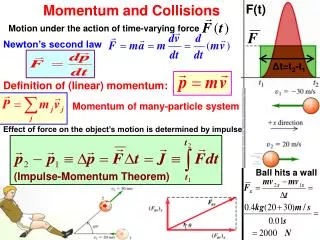
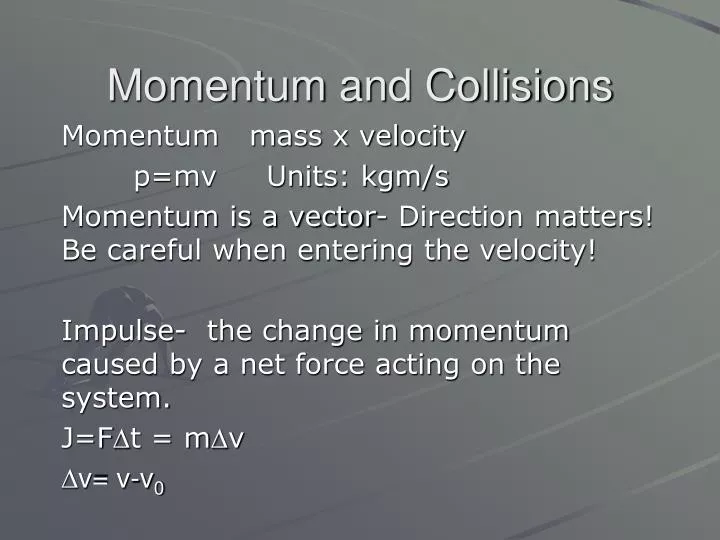
Momentum and Collisions Momentum mass x velocity p=mv Units: kgm/s Momentum is a vector- Direction matters! Be careful when entering the velocity! Impulse- the change in momentum caused by a net force acting on the system. J=FDt = mDv Dv= v-v0
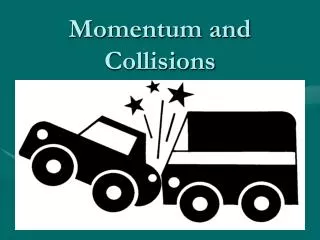
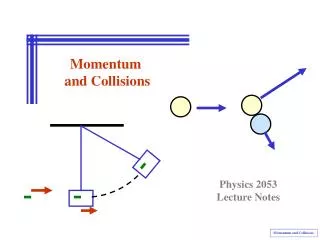
Collisions • Two major types, Elastic, Inelastic Momentum is conserved in collisions. Momentum Before=Momentum After • Elastic Collision Objects bounce off of each other No lasting deformity No heat generated Kinetic Energy is also conserved
Inelastic Collisions Lasting deformity occurs Objects either stick together at the beginning and separate, or stick together at the end. Kinetic Energy is not conserved, since there is energy lost to heat.