The Evolution of Spaceflight: From Ancient China to Modern Space Exploration
This timeline captures the remarkable journey of space exploration, beginning with the Chinese invention of fireworks and gunpowder around the 2nd century BCE, leading to Robert Goddard's groundbreaking work on liquid fuel rockets in 1926. Key milestones include WWII advancements like the German V-2 rockets, the sound barrier breach by Chuck Yeager in 1947, and the Soviet launch of Sputnik in 1957. It highlights pivotal achievements in both American and Russian manned space programs, detailing significant missions and the evolution of rocket technology that has propelled humanity into space.

The Evolution of Spaceflight: From Ancient China to Modern Space Exploration
E N D
Presentation Transcript
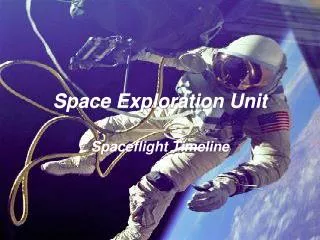
Space Exploration Unit Spaceflight Timeline
Chinese Invention of Fireworks and Gunpowder • Gunpowder and Fireworks invented in China 2 century BCE. • Gunpowder, a mixture composing of: 75% Potassium Nitrate (KNO3), 15% Charcoal (Carbon), and 10% Sulfur, provides the thrust for most fireworks.
Robert Goddard • Invented the liquid fuel rocket • “Nell” Flew on March 16th, 1926 • “Father of Modern Rocketry” • Solid fuel: must have air to combust. Once started, must burn out • Liquid fuel: some fuels can react with no air. Engines can be shut down and restarted.
WWII Germany and the V-2 • German scientists led by Herman Oberth and Werner Von Braun picked Goddard’s brain to develop their own rockets capable of space travel. • Hitler forced this research group to develop a missile that could carry a warhead to Britain. • 1,100 V-2 rockets would impact England in World War II.
Birth of the Jet • Also during WWII, the Germans pioneered the first “practical” jet engine. They would be the only country to successfully use jets during the war.
Breaking the Sound Barrier • Shortly after the war, the U.S. leads the way in developing high performance aircraft. • Pilots and Engineers notice terrible turbulence as planes approach 760 miles per hour-the speed of sound when most crashed due to lack of stability. • Bell laboratories develops the first aircraft, technically a rocket plane” capable of breaking the sound barrier. • October 14th, 1947 test pilot, Chuck Yeager, becomes the first person to exceed the sound barrier in the Bell X-1
Russian rocket engineer Sergei Korolev heads the post war spaceflight efforts of the U.S.S.R. after being imprisoned during at the end of WWII. Korolev helps Russia develop the most powerful and dependable rocket engines of the space race. Postwar Russia-The Race to Space
Sputnik • In order to launch a satellite first, Korolev removes scientific instruments and leaves only a transmitter so that the weight is acceptable. • October 4, 1957 - Sputnik 1, the first man-made object to orbit the Earth, is launched by the U.S.S.R., and remains in orbit until January 4, 1958. • November 3, 1957 - Sputnik 2, carrying the dog Laika for 7 days in orbit, is launched by the U.S.S.R., and remains in orbit until April 13, 1958.
Explorer I • January 31, 1958 - Explorer 1, the first U.S. satellite in orbit, lifts off at Cape Canaveral using a modified ABMA-JPL Jupiter-C rocket. It carries a scientific experiment of James A. Van Allen, and discovers the Earth's radiation belt. • March 5, 1958 - Explorer 2 is launched by a Jupiter-C rocket, and fails to reach orbit.
Yuri Gagarin • April 12, 1961 - Vostok 1 is launched by the U.S.S.R., carrying Cosmonaut Yuri A. Gargarin, the first man in space. • He orbits the Earth once. • Cosmonaut literally means “Voyager of the Cosmos”
Alan B. Sheppard • May 5, 1961 - Mercury Freedom 7 carries Alan B. Sheppard, Jr., the first U.S. Astronaut into space, in a 15 minute suborbital flight. • The 7 original Mercury Astronauts: Alan Sheppard Virgil I. “Gus” Grissom John H. Glenn-1st American to Orbit Earth Walter Schirra Scott Carpenter Gordon “Gordo” Cooper *Deke Slayton • Astronaut means “Star Voyager”
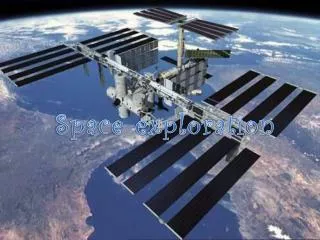
Russia’s Manned Space Program • Vostok • Voshkod • Soyuz • Salyut • Mir • ISS
U.S. Manned Space Program • Mercury • Gemini • Apollo • Apollo-Soyuz • Skylab • Space Shuttle • ISS • Constellation