Exploration of the Outer Planets: Uranus, Neptune, and Pluto
This overview explores the outer planets of our solar system: Uranus, Neptune, and Pluto. Uranus, with a diameter four times that of Earth, is located about 3 billion km from the Sun and takes 84 years to complete its orbit. Neptune, slightly smaller, orbits 4.5 billion km away and has a striking Great Dark Spot. Pluto, the smallest dwarf planet, boasts an elliptical orbit that crosses Neptune’s path. The Kuiper Belt, home to many comets and "plutinos," lies beyond these planets. Discover the unique characteristics and mysteries of these distant worlds!

Exploration of the Outer Planets: Uranus, Neptune, and Pluto
E N D
Presentation Transcript
The Outer Planets Uranus, Neptune and Pluto
Uranus • About 4 times diameter of Earth • 3 billion km (1-3/4 billion miles) from Sun • 84 Years to Circle Sun • Rotates in 16 hours • Five large satellites (500-1500 km), ten smaller ones • Nine narrow rings
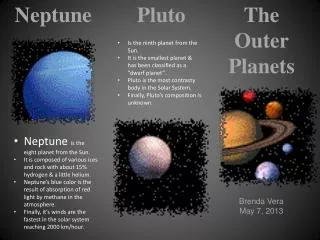
Neptune • About 4 times diameter of Earth- a bit smaller than Uranus • 4.5 billion km (2.8 billion miles) from Sun • 165 Years to Circle Sun • Rotates in 18 hours • One large satellite (2700 km), seven smaller ones • Four narrow rings
Pluto • At 2300 km, Pluto is the smallest planet • Has most elliptical orbit: ranges from 4.4 to 7.4 billion km from Sun (2.8-4.5 billion miles) • Actually crosses orbit of Neptune; closer to Sun than Neptune until 2009 • Orbits in 248 years, 1.5 times Neptune • Because of orbital tilt and resonance, cannot collide with Neptune
Pluto and Charon • Pluto’s moon Charon is almost half as big as Pluto (1100 km) • Orbits only 20,000 km away • Pluto and Charon always keep same face to each other (rotation locked) • Pluto rotates, and Charon revolves, in 6.4 days
Plutinos and the Kuiper Belt • The Kuiper Belt is an outer ice asteroid belt, probably the source of most comets • Over 50 are now known orbiting beyond Neptune, some beyond Pluto • Pluto is probably just the biggest of these objects (not really a planet?) • Several dozen have periods similar to Pluto’s - 250 years - and have been dubbed “plutinos.”