Download
1 / 20
200 likes | 316 Views
This material covers the fundamental aspects of discrete linear inverse problems, focusing on the mathematical modeling of data and the application of various estimation methods. We explore both forward and inverse problems, detailing techniques such as the least squares method for parameter estimation. Additionally, we categorize inverse problems based on the nature of the data, discussing over-determined, under-determined, and mixed-determined problems. The text also delves into options for regularization, constraints on estimation, and the importance of additional information in finding solutions.

E N D
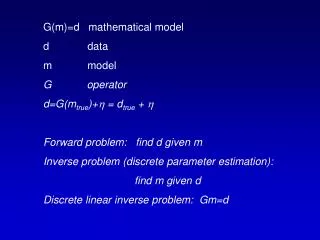
G(m)=d mathematical model d data m model G operator d=G(mtrue)+ = dtrue + Forward problem: find d given m Inverse problem (discrete parameter estimation): find m given d Discrete linear inverse problem: Gm=d
G(m)=d mathematical model Discrete linear inverse problem: Gm=d Method of Least Squares: Minimize E=∑ ei2 = ∑ (diobs-dipre)2 dipre Diobs zi o ei o o o o
E=eTe=(d-Gm)T(d-Gm) =∑ [di-∑Gijmj] [di-∑Gikmk] =∑ ∑ mj mk ∑ Gij Gik -2∑ mj ∑ Gijdi + ∑ di di ∂/∂mq [∑ ∑ mj mk ∑ Gij Gik ] = ∑ ∑ [jqmk+mjkq]∑GijGik = 2 ∑ mk ∑ Giq Gik -2 ∂/∂mq [∑ mj ∑ Gijdi ] = -2∑jq∑Gijdi = -2∑ Giqdi ∂/∂mq [∑didi]=0 i j k j k ij i i j k ij k i k i j I j i i i
∂/∂mq = 0 =2 ∑ mk ∑ Giq Gik - 2∑ Giqdi In matrix notation: GTGm - GTd = 0 mest = [GTG]-1GTd assuming [GTG]-1 exists This is the least squares solution to Gm=d k i i
Example of fitting a straight line mest = [GTG]-1GTd assuming [GTG]-1 exists m ∑ xi ∑ xi ∑ xi2 1 1 … 11 x1 [GTG]= 1 x2 = x1 x2 .. xm . 1 xm [GTG]-1 = m ∑ xi -1 ∑ xi ∑ xi2
Example of fitting a straight line mest = [GTG]-1GTd assuming [GTG]-1 exists ∑ di ∑ xi di 1 1 … 1 d1 [GTd]= d2 = x1 x2 .. xm . dm [GTG]-1 GTd= m ∑ xi -1 ∑ xi ∑ xi2 ∑ di ∑ xi di
The existence of the Least Squares Solution mest = [GTG]-1GTd assuming [GTG]-1 exists Consider the straight line problem with only 1 data point ? ? ? m ∑ xi -1 1 x1 -1 [GTG]-1 = = ∑ xi ∑ xi2 x1 x12 o The inverse of a matrix is proportional to the reciprocal of the determinant of the matrix, i.e., [GTG]-1 1/(x12-x12), which is clearly singular, and the formula for the least squares fails.
Classification of inverse problems: Over-determined Under-determined Mixed-determined Even-determined
Over-determined problems: Too much information contained in Gm=d to possess an exact solution … Least squares gives a ‘best’ approximate solution.
Even-determined problems: Exactly enough information to determine the model parameters. There is only one solution and it has zero prediction error
Under-determined Problems: Mixed-determined problems - non-zero prediction error Purely underdetermined problems - zero prediction error
Purely Under-determined Problems: # of parameters > # of equations Possible to find more than 1 solution with 0 prediction error (actually infinitely many) To obtain a solution, we must add some information not contained in Gm=d : a priori information Example: Fitting a straight line through a single data point, we may require that the line passes through the origin Common a priori assumption: Simple model solution best. Measure of simplicity could be Euclidian length, L=mTm = ∑ mi2
Purely Under-determined Problems: Problem: Find the mest that minimizes L=mTm = ∑ mi2 subject to the constraint that e=d-Gm=0 (m)= L+∑ i ei = ∑ mi2 +∑ i [ di - ∑ Gijmj ] ∂(m)/∂mq= 2 ∑ mi ∂mi/∂mq-∑ i ∑ Gij∂mj /∂mq] = 2mq - ∑ iGiq = 0 In matrix notation: 2m = GT (1), along with Gm=d (2) Inserting (1) into (2) we get d=Gm=G[GT/2] , = 2[GGT]-1d and inserting into (1): m = GT [GGT]-1d - solution exist when purely underdetermined
Mixed-determined problems Over Under Mixed determined determined determined Partition into overdetermined and underdetermined parts, solve by LS and minimum norm - SVD (later) Minimize some combination of the prediction error and solution length for the unpartitioned model (m)=E+2L=eTe+2mTm mest=[GTG+2I]-1GTd - damped least squares
Mixed-determined problems • (m)=E+2L=eTe+2mTm • mest=[GTG+2I]-1GTd - damped least squares • Regularization parameter 0th-order Tikhonov Regularization ||m|| ||Gm-d|| Min ||m||2, ||Gm-d||2< min ||Gm-d||2, ||m||2 < ||m|| ‘L-curves’ ||Gm-d||
Other A Priori Info: Weighted Least Squares Data weighting (weighted measures if prediction error) E=eTWee We is a weighting matrix, defining relative contribution of each individual error to the total prediction error (usually diagonal). For example, for 5 observations, the 3rd may be twice as accurately determined as the others: Diag(We)=[1, 1, 2, 1, 1]T Completely overdetermined problem: mest=[GTWeG]-1GTWed
Other A Priori Info: Constrained Regression di=m1+m2xi Constraint: line must pass through (x’,d’): d’=m1+m2x’ Fm= [1 x’] [m1 m2]T = [d’] Similar to the unconstrained solution (2.5) we get: m1est M ∑ xi 1 -1 ∑ di m2est = ∑ xi ∑xi2 x’ ∑ xidi 11 x’ 0 d’ o o (x’,d’) o o d x o Unconstrained solution: [GTG]-1 GTd= M ∑ xi -1 ∑ xi ∑ xi2 ∑ di ∑ xi di
Other A Priori Info: Weighting model parameters Instead of using minimum length as solution simplicity, One may impose smoothness in the model: -1 1 m1 -1 1 m2 l = . . . = Dm . . . -1 1 mN D is the flatness matrix L=lTl=[Dm]T[Dm]=mTDTDm=mTWmm, Wm=DTD firsth-order Tikhonov Regularization - min||Gm-d||22+||Lm||22
Other A Priori Info: Weighting model parameters Instead of using minimum length as solution simplicity, One may impose smoothness in the model: 1 -2 1 m1 1 -2 1 m2 l = . . . . = Dm . . . . 1 -2 1 mN D is the roughness matrix L=lTl=[Dm]T[Dm]=mTDTDm=mTWmm, Wm=DTD 2nd-order Tikhonov Regularization- min||Gm-d||22+||Lm||22