Download
1 / 24
240 likes | 367 Views
Thousand Cankers Disease is a serious affliction affecting certain walnut trees, primarily caused by the walnut twig beetle and a associated fungus, Geosmithia morbida. This disease is prevalent in western and southwestern regions of the U.S., including Tennessee, and poses a significant threat to Eastern black walnut trees as it spreads eastward. With no known control methods, it is critical to minimize the risk of introduction through effective prevention strategies such as regulation, outreach, and early detection. Learn more about the impacts and actions we can take to safeguard our forests.

E N D
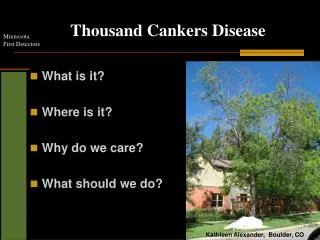
Thousand Cankers Disease • What is it? • Where is it? • Why do we care? • What should we do? Kathleen Alexander, Boulder, CO
Thousand Cankers Disease • What is it? A disease of some walnut trees that is caused by an insect and a fungus • Where is it? In western and southwestern areas of the United States; in Tennessee • Why do we care? Because as it spreads eastward, it threatens native eastern black walnut • What should we do? Prevention: reduce risk of introduction
www.plantcare.com/.../black-walnut-2127.aspx Thousand Cankers Disease: What is it? A disease of some walnut trees (Juglans species) • Two occur in Minnesota Butternut (Juglans cinerea): Unknown susceptibility Eastern black walnut (Juglans nigra): Very susceptible www.plantcare.com/.../black-walnut-2127.aspx • www.tree-pictures.com/butternut_tree_photos.html
Thousand Cankers Disease: What is it? • ….. caused by a tiny insect that feeds and tunnels in the inner bark of the trunk and branches Walnut twig beetle Pityophthorus juglandis Tunneling Entry / exit holes Whitney Cranshaw, Colorado State University, Bugwood.org W. Cranshaw , Colorado State Univ. www.forestryimages.org
Thousand Cankers Disease: What is it? • The walnut twig beetle introduces a fungus - Geosmithia morbida • that kills the bark and phloem, causing a canker Jim LaBonte, OR Dept. Agric. Whitney Cranshaw, Colorado State University, Bugwood.org “Canker: A visible dead area, usually of limited extent, in the cortex or bark of a plant.” (Tainter & Baker, 1996) Ned Tisserat, Colorado State University
Thousand Cankers Disease: What is it? • Cankers coalesce, eventually girdling and killing the branch or trunk Ned Tisserat, Colorado State University
Thousand Cankers Disease: What is it? Crown symptoms: Yellowing & wilting foliage, followed by branch dieback & death may occur in susceptible species Kathleen Alexander , City Forester, Boulder, CO Whitney Cranshaw, Colorado State University
Thousand Cankers Disease: Where is it? States in red & Tennessee Confirmed July 2010 Original host, Arizona walnut Juglans major
Thousand Cankers Disease: Where is it? KY MO • Black walnut dieback for 2+ years. • TCD confirmed July 2010. • TCD confirmed in 4 counties. • Surveys initiated in neighboring states. VA NC 1st report in native range Knoxville, TN Source: M. Mielke NCFPW 2010 MS AL GA Urban settings news.tennesseeanytime.org/node/5926
Thousand Cankers Disease: Why do we care? …because it threatens eastern black walnut in its native range & there is no control
Thousand Cankers Disease: Why do we care? 5.9 million
Thousand Cankers Disease: Why do we care? • In Minnesota • 5.9 million trees (Winona, Wabasha, Fillmore Counties each have > 1 million black walnut trees) • Annual state harvest – • 1-2 million board feet • 0.1% volume of all wood harvested • $3 million • 5% of $60 million total stumpage value for all wood harvested • 30% exported, mainly to Wisconsin, Iowa • 40+ mills in Minnesota use walnut;12% imported, mainly from Wisconsin and Iowa; bark on.
Thousand Cankers Disease: Why do we care? Other impacts • Ecologic • Harder to measure • Nuts as food for wildlife • Important species of riparian corridors • Bark used for medicine, dye • Social • Culture around walnuts for food
Thousand Cankers Disease: What should we do? PREVENTION • Minimize the risk of introduction • MOST IMPORTANT PATHWAY • = • Wood with bark: • logs for veneer • pieces for woodworking • firewood Natural spread: Walnut twig beetle can fly 1 – 2 miles, and be carried by wind
Thousand Cankers Disease: What should we do? Tools for prevention • Regulation • Outreach • Early detection
Thousand Cankers Disease: What should we do? Regulation • Who regulates? • Infested western states No • APHIS No • Eastern states Yes
Thousand Cankers Disease: Regulation State Quarantines Exterior quarantines Exterior quarantines ? In progress In progress Interior quarantine Source: E.Borchardt, MN Dept. Agric.
Thousand Cankers Disease: What should we do? Outreach! • Newsletters, websites • Telephone, email, visits • Presentations • TO • Partner organizations • Mill owners, loggers • Landowners • Tree care companies • Nurseries Photos courtesy of Mike Greenheck, Forest Field Day , Gorman Creek Farm, Kellogg, MN, October 2010
Thousand Cankers Disease: What should we do? Early Detection • First detector training • MDA/USFS survey for suspect trees: Call Arrest the Pest Hotline 651-201-6684 1-888-545-6684 OR follow instructions on survey form to contact Jennifer Juzwik, USFS 651-649-5114 jjuzwik@fs.fed.us Kathy Kromroy, MDA 651-201-6343 kathryn.kromroy@state.mn.us
Early Detection: Does your black walnut have TCD? • Early symptoms (late June to late August) Tree may be infested 6-8 years before see crown symptoms Area of thinning crown Yellow or wilting leaves Attached brown leaves Leaves smaller than healthy leaves
Early Detection: Does your black walnut have TCD? • Actively declining symptoms Rapid wilting Cankers on branch below wilting foliage Reducedlive crown on trees affected previous season
Early Detection: Does your black walnut have TCD? • Late symptoms • Many tiny holes on branches >1.5 inches • Galleries and meandering tunnels • Small cankers in inner bark if scrape away outer bark • Large dead areas on branches & stems
Early Detection: Does your black walnut have TCD? • What else may be confused with Thousand Cankers Disease? • Nectria cankers Fusarium cankers -similar decline Anthracnose • Other beetles Hail injury, storm damage • Squirrel girdling of branches
Acknowledgements • Jenny Juzwik, Mike Ostry, Paul Castillo. USFS Northern Research Station. • Manfred Mielke. USFS State & Private Forestry. • Keith Jacobsen, Lance Sorenson.MN DNR. • Mike Greenheck. Gorman Creek Farms, Kellogg MN. • Mel Baughman, Angie Gupta. UM Extension.