Exploring Comparative Cognition: Understanding Animal Minds and Behavior
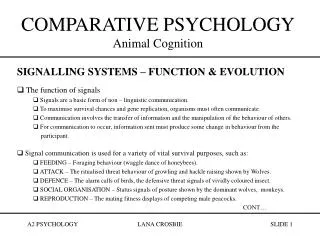
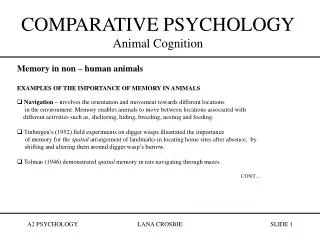
Comparative cognition examines the mental abilities of species, highlighting the degree of difference in cognition between humans and animals. It involves studying fundamental cognitive processes like perception, memory, and social cognition through unique animal properties and various research approaches such as naturalistic observation and behavioral neuroscience. Researchers analyze how cognitive traits develop, their functions, and evolutionary aspects, providing insight into how diverse species think and behave, while also exploring topics ranging from basic processes to social relationships and ethical considerations.

Exploring Comparative Cognition: Understanding Animal Minds and Behavior
E N D
Presentation Transcript
Comparative Cognition Today January 12, 2010
Overview What is comparative cognition? What is studied? What approaches are taken?
Comparative Cognition • Darwin: • “the difference in mind between man and the higher animals, great as it is, certainly is one of degree and not of kind” • Comparative cognition is: • A comparison of mental abilities of species • Cognitive abilities and capabilities • e.g. capabilities: Alex the Grey Parrot
Past approaches From Shettleworth (2009), Behav Process. 80, 210-217 • Review from last class • American vs European approaches • Species used:
Why Psychology? • Why is animal behaviour studied in psych department, not zoology? • 4 main reasons: • Uniqueness • Control & irreversible effects • Simplicity & generality • Continuity
Uniqueness • Certain animals have unique properties that allow us to study subjects which could not be studied any other way: • Mice and genes • Giant Squid Axons • High pecking rates of pigeons • Echolocation in bats • Absolute pitch in songbirds
Control & Irreversible Effects • For practical and ethical reasons, we can have greater control in animals over both: • Genes • Environments • Irreversible Effects: • Drugs, lesions, gene manipulations
Simplicity & Generality • Insights from Model Systems • Mendel studied peas • Impact on study of schizophrenia • Generality of principles • Building blocks of cognition
Continuity • Neurobiological continuity • e.g. Hippocampal lesions in mice and men • Evolutionary continuity • Divergent and convergent evolution • Analagous vs homologous traits
Continuity Time Pigeons Mice Rats Humans
Continuity Time Pigeons Mice Rats Humans
3 main areas: • Basic processes • Physical cognition • Social cognition
Basic Processes • Includes: • Perception • Attention • Memory • Associative leaning • Category and concept learning
Physical Cognition • Includes: • Time • Space • Number • Tool Use • Causal understanding
Social Cognition • Includes: • Social networks • Dominance structures • Social Relationships • Morality and ethics • Theory of Mind • Social learning • Observational learning • Imitation • Communication & Language
Aspects of Cognition How is information acquired or learned? How is information processed? How is information retained?
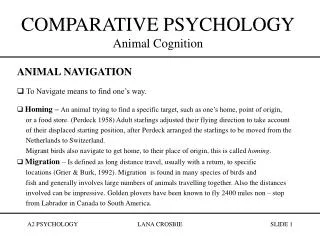
Types of Studies 4 approaches to studying animal behaviour: Naturalistic Observation (Ethological) Field Experiments Behavioural Experiments Behavioural Neuroscience (Physiological)
Tinbergen’s Four Questions • Named for ethologist Niko Tinbergen • Proximate (How) vs Ultimate (Why)
Proximate Questions • Causation: • Brain – e.g. Broca’s area • Hormones – e.g. Testosterone stimulates aggressive behaviour • Pheremones – e.g. Spatial behaviour, tracking • Development or Ontogeny • Nature/Nurture – genes and environment • Critical periods – e.g. language or imprinting
Ultimate Questions • Function or Adaptation • How has an organism evolved for survival? • e.g. Birds fly south for warmth & food • e.g. Mammal nurture young • Phylogeny • Evolutionary explanations, other than adaptation • e.g. Genetic drift