Understanding Genetic Traits: PTC Tasting, Tongue Rolling, and Earlobe Attachment
This article explores the intriguing genetic traits of PTC tasting, tongue rolling, and earlobe attachment. PTC (phenylthiocarbamide) tasting is controlled by a dominant gene, with 70% of the U.S. population able to taste it. Tongue rolling, also influenced by a dominant trait, has around 70% prevalence but shows variability in inheritance among twins. Lastly, earlobe attachment features both dominant detached earlobes and recessive attached ones; however, its genetic basis remains debated. Discover how these traits illustrate the complexity of heredity.

Understanding Genetic Traits: PTC Tasting, Tongue Rolling, and Earlobe Attachment
E N D
Presentation Transcript
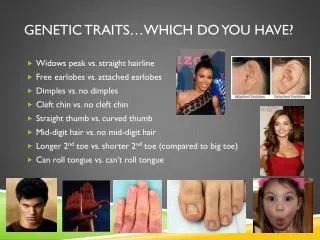
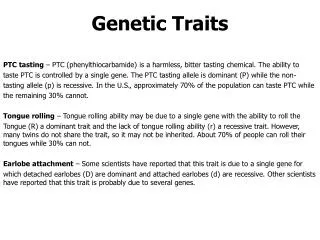
Genetic Traits PTC tasting – PTC (phenylthiocarbamide) is a harmless, bitter tasting chemical. The ability to taste PTC is controlled by a single gene. The PTC tasting allele is dominant (P) while the non- tasting allele (p) is recessive. In the U.S., approximately 70% of the population can taste PTC while the remaining 30% cannot. Tonguerolling– Tongue rolling ability may be due to a single gene with the ability to roll the Tongue (R) a dominant trait and the lack of tongue rolling ability (r) a recessive trait. However, many twins do not share the trait, so it may not be inherited. About 70% of people can roll their tongues while 30% can not. Earlobe attachment – Some scientists have reported that this trait is due to a single gene for which detached earlobes (D) are dominant and attached earlobes (d) are recessive. Other scientists have reported that this trait is probably due to several genes.