Download
1 / 18
180 likes | 296 Views
This lesson focuses on the energy changes that occur during chemical reactions, including the classification of reactions as exothermic or endothermic. Students will learn how chemical energy is involved in bond breaking and forming, and how energy is conserved throughout these processes. Through examples, such as the combustion of propane or the melting of butter, learners will identify heat changes and categorize reactions accordingly. This comprehensive overview equips students with the tools to analyze real-life reactions related to energy changes.

E N D
Energy Changes in Reactions Physical Science December 7, 2011 Ms Cilli Pages 206-209
Objectives • Describe the energy changes that take place during chemical reactions. • Classify chemical reactions as exothermic or endothermic. • Explain how energy is conserved during chemical reactions.
What type of reaction is this? C3H8 + 5O2 3CO2 + 4H2O
What is chemical energy? • Chemical Energy: • Chemical reactions involve the ________ of bonds in the reactants and the ________ of bonds in the products.
Energy in or out? Breaking bonds Forming Bonds
Remember Phase Changes?!?! Is heat lost or gained? 1. A plastic bottle of water is placed in a freezer. After several hours, the water has frozen solid. 2. A chef places a stick of solid butter in a saucepan, and heats the saucepan over low heat on a stove. After several minutes, the stick of butter has melted.
Will you either come in or go out? Exothermic: Endothermic:
Is heat lost or gained? Exothermic or Endothermic? 1. A plastic bottle of water is placed in a freezer. After several hours, the water has frozen solid. 2. A chef places a stick of solid butter in a saucepan, and heats the saucepan over low heat on a stove. After several minutes, the stick of butter has melted.
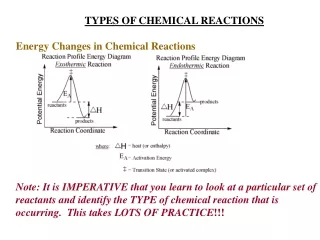
Exothermic Reaction Example Heat is on the _____ side
Endothermic Reaction Example Heat is on the _____ side
Tale of Two Reactions Is it endothermic or exothermic? (Look and ask yourself what side the heat is on) C3H8 + 5O2 3CO2 + 4H2O + 2220kJ 2HgO + 181.7 kJ 2Hg + O2
Closure…onestepcloser Which one is not one of the 5 types of chemical reactions? • synthesis • decomposition • single-replacement • double-replacement • All of these are chemical reactions
Assignment: • Independent Practice: • Read section 7.3 • Work on the study guide • Homework: • Complete the section 7.3 HW • Due Thursday, December 8 by 8PM