Key Factors Behind College Dropout Rates: Understanding Social, Financial, and Academic Challenges
This paper explores the top three causes of college dropouts: social issues, financial preparedness, and academic readiness. It highlights social challenges such as feelings of isolation and lack of belonging, financial barriers like tuition costs and employer reimbursements, and academic deficiencies stemming from high school experiences. Recommendations for improvement include monthly email notifications to students, enhanced financial aid education, and the importance of remedial courses and learning enhancement programs. The insights aim to foster better retention rates among college students.

Key Factors Behind College Dropout Rates: Understanding Social, Financial, and Academic Challenges
E N D
Presentation Transcript
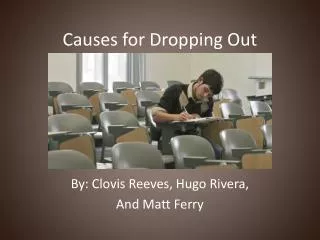
Causes for Dropping Out By: Clovis Reeves, Hugo Rivera, And Matt Ferry
Top Three Causes • Not fitting in socially • Not being financially prepared • Not being academically prepared
Social Issues • Participation, Belonging, Lack of Events • Homesick, Isolation, Depression • Failure to attend classes
Recommendation • E-mail notifications at the beginning of each month to students. • Encourage teamwork • Provide more events
Finances • Tuition / Course costs • Not planning far enough ahead • Tuition due vs. Employer reimbursements
Recommendations • Explaining financial aid • Have a better understanding of how the degree will be financed • Three-way contracts between the employer, student, and college
Academic Preparedness • High school way to the college way • Parents’ influence • High School • 1/3 of adult students will drop
Recommendations • High school students need to get a jump start on college • More influence on parents’ involvement • Remedial courses still need to be taught so the students can comprehend the material. • Learning enhancement activities: • Accelerated learning programs • Placement Activities • Tutor service
Conclusion Thank You
References • Benchmarking & benchmarks: Effective practice with enteringstudents.(2009).Center for Community College Student Engagement. Austin, TX: The University of Texas at Austin, Community College Leadership Program. • Fincher, M. (2010). Adult student retention: A practical approach to retention improvement through learning enhancement. Journal of Continuing Higher Education, 58(1), pp. 12-18. Retrieved January 28, 2011, from EBSCOhost. • Flint, T. A., & Frey, R. (2003). Alternative programming for adults. New Directions for Student Services, (102), pp. 69-79. Retrieved February 3, 2011, from EBSCOhost. • Raley, Y. (2007). Why we quit. Scientific American Mind, 18(4), pp.74-79. Retrieved January 13, 2011, from EBSCOhost. • Whitbourne, J. (2002). The dropout dilemma. Careers & Colleges, 22(4), pp. 26-31. Retrieved January 20, 2011, from EBSCOhost.