Download
1 / 13
130 likes | 251 Views
This paper explores the integration of first-order logic SMT solvers for automatic program verification. It addresses the challenges of comprehensions and their representation in higher-order bindings, promoting the use of template functions to facilitate their verification. The authors demonstrate the generation of axioms that define these functions, apply logical quantifiers, and provide successful implementation examples in Spec#. They highlight the importance of trigger engineering for effective quantifier instantiation and advocate for the verification of more complex programs with expressive specifications.

E N D
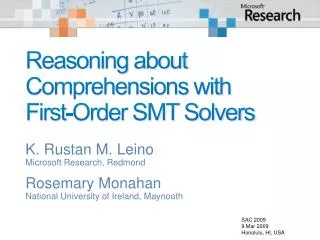
Reasoning about Comprehensions withFirst-Order SMT Solvers K. Rustan M. Leino Microsoft Research, Redmond Rosemary MonahanNational University of Ireland, Maynooth SAC 2009 9 Mar 2009 Honolulu, HI, USA
Goal • Automatic program verification • program + specificationsautomaticallylead to proofs/refutations • …with support for: • modern programming language features • expressive specifications • In this paper: • We add support for commoncomprehension expressions
Challenges • Comprehensions are like higher-order bindings • Automatic provers use first-order logic
Solution: Template functions • Introduce a first-order function for each comprehension template • Examples: = f(0, N, a, b) free variables bounds
Solution: Template functions • Introduce a first-order function for each comprehension template • Examples: same template, different parameterizations = f(0, N, a, b) = g(0, N, a) = g(12, 100, b)
Solution (cont.): Axioms • Generate axioms that define the template functions • Examples • Empty range(lo,hi,a hi ≤ lo f(lo,hi,a) = 0) • Induction(lo,hi,a lo ≤ hi f(lo,hi+1,a) = f(lo,hi,a) + a[hi]) • Range split(lo,mid,hi,a lo ≤ mid ≤ hi f(lo,mid,a) + f(mid,hi,a) = f(lo,hi,a))
Using logical quantifierswith an SMT solver • Universal quantifiers are instantiated to produce more ground facts • Matching triggers guide the instantiation
Trigger engineering • (a f(0,0,a) = 0) • (lo,hi,a hi ≤ lo f(lo,hi,a) = 0)
Trigger engineering • (lo,mid,hi,a lo ≤ mid ≤ hi f(lo,mid,a) + f(mid,hi,a) = f(lo,hi,a)) • (lo,mid,hi,a lo ≤ mid ≤ hi f(lo,mid,a) + f(mid,hi,a) = f(lo,hi,a))
Implementation, experiments • Implementation in Spec# • sum, product, count, min, max • Verification of several examples fromthe Dijkstra & Feijen textbook • Teaching
Performance *) /inductiveMinMax:4
Conclusions • Higher-order features can be usefully encoded in first-order logic for SMT solvers • Good trigger engineering is crucial • Read this paper! • Future work • Support general λ-expressions, collection comprehensions • Verify more programs • Download Spec# and teach • http://research.microsoft.com/specsharp