Download
1 / 19
190 likes | 284 Views
Explore the relevance of instructivist and constructivist models in teaching geology and geophysics, with insight on content, strategies, implicit goals, and technology support for effective learning. Learn through case studies and interactive approaches to improve students' understanding and decision-making skills.

E N D
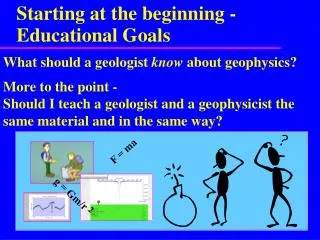
g = Gm/r 2 Starting at the beginning - Educational Goals What should a geologist know about geophysics? More to the point - Should I teach a geologist and a geophysicist the same material and in the same way? F = ma
Instructivist Model: Example Exploration Using Gravity A Reductionist program taught through Reductionism • Describe Mathematical Foundations General • Describe Physical Foundations • Derive Equations for Particular Examples • Discuss Practical Consequences Particular • Apply Results
What Are We Teaching? Implicit Goals - Instructivist Model • Emphasizes underlying connections to, and descriptions based on, fundamental mathematics and physics. • Procedural implementation stressing derivations and linear decision structures. • Inculcates students into reductionist modes of thinking.
How Are We Teaching? Strategies – Instructivist Model • Learn from general to particular. • Learning accomplished primarily through memorization and mathematical descriptions, physical/intuitive insight downplayed. • Sequential access to information as dictated by reductionist/constructivist needs.
Constructivist Model: Example Exploration Using Gravity An inquiry-based program taught through active exploration • Explore Specific and Relevant Problems Particular • Develop Intuitive Understanding of Physical Foundations • Gain Mastery of Background Material as Needed • Through Examination of Multiple Problems Develop Generalizations General
What Are We Teaching? Implicit Goals – Constructivist Model • Conceptual understanding of physical principles. • Mathematical development not emphasized in building intuitive understanding. • Decision-making processes emphasized that are inherently nonlinear in implementation. • Inculcates students into a system-oriented mode of thinking.
How Are We Teaching? Strategies – Constructivist Model • Learn from particular to general. • Learning accomplished primarily by solving problems of interest (learning by doing). • Just-in-time access to a wide variety of information as needed by students in a nonlinear way.
Intro GP Implementation Guidelines • Inquiry Based • Students placed in the role of geophysical contractors. They must bid on jobs, design surveys, collect data, and interpret observations • Interactive Case Study Approach • Students control all relevant decisions regarding outcome of case • Simulated Observations • Allows for quantitative error analysis, ground truthing, and assessment of cost/benefit tradeoff associated with survey design issues
Instructional Design • K. Ginger designed interface and workflow • Component Implementation • HTML, Java, and JSP • Application Server Requirements • JDK, Tomcat Implementation Components and Skills • Content Knowledge - Duh!! • Technical Expertise
x = 10 m t = 120 min Bid = $13,950 Cost = $6320 GP311 Data Example Distance (m)
x = 3 m t = 180 min Bid = $25,000 Cost = $16,800 GP311 Data Example Distance (m)
x = 3 m t = 120 min Bid = $11,660 Cost = $22,320 GP311 Data Example Distance (m)
Lessons from GP311: Changing roles Not only how students learn, but ... how instructors teach.
Written assignments due weekly (project reports) • Respond to client questions weekly • Ask questions! Lessons from GP311: Implementation • 20 - 30 students • 12 hours/week contact time • No formal lectures!
No direct exposure to the predictive power of mathematical descriptions • Perception that technology makes learning easy Lessons from GP311: Limitations • Limited exposure to real, hands-on experiences • Students tend to focus too tightly on specific problems, thereby missing the big picture