Download
1 / 12
120 likes | 234 Views
The Semantic Web Services Language Committee, initiated in late 2002, has actively worked on defining technological foundations for web services aligned with the Semantic Web vision. Key activities began in March 2003, with weekly teleconferences and a public mailing list. The committee has produced a mission statement, developed a requirements document, and is studying various relevant technologies. Objectives include automating web service interactions and developing a standardized language for semantic information. Recent members include experts from IBM Watson and Stanford.

E N D
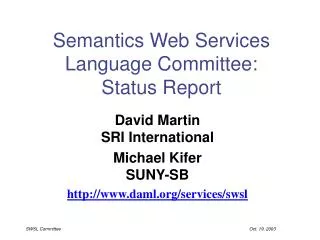
Semantics Web Services Language Committee:Status Report David MartinSRI International Michael KiferSUNY-SB http://www.daml.org/services/swsl
Administrative • Committee started forming in late 2002 • Full committee activities started March 2003 • Weekly telecons • Public mailing list: www-ws@w3.org • Web site: http://www.daml.org/services/swsl • Membership • Newest: Richard Goodwin (IBM Watson) Deb McGuinness (Stanford KSL) Ian Horrocks (U. Manchester) • F2F meeting primary goal: achieve substantial agreement on content of requirements document
Activities • Produced mission statement and workplan • Requirements document under development • http://www.daml.org/services/swsl/requirements/ • Study of selected relevant technologies • E.g. PSL, F-Logic, BPEL4WS, E-Service Composition • Collecting use cases • Use case repository established; starting to grow: http://www.daml.org/services/use-cases.html • Discussion of general language requirements; e.g. • Monotonic vs. non-monotonic logics • Comparative approaches (FOL, F-Logic, Ontology-based)
Mission & Objectives • Identify and develop technology that will provide a firm, longterm foundation for the future of Web services on the Internet • Support the most general approaches to service deployment and use that are currently technically feasible • … Consistent with the vision of the Semantic Web • … builds on and maximally consistent with commercial work on Web services • Provide a longer term perspective to the Web services standards community
Mission & Objectives (2) • Sevelop standardized ways of conceptualizing and organizing semantic information about services. • Develop a language for the declarative specification of this semantic information. • Enable automation and dynamism in all aspects of Web service provision and use, such as discovery, selection, composition, negotiation and contracting, invocation, monitoring of progress, and recovery from failure; • Be extensible and allow for incremental exploitation; • Support a style of service use that is closely integrated with information resources on the Semantic Web; • Support the construction of powerful tools and methodologies. • Collaborative with architecture committee
Workplan • Identify requirements for Web service description language(s) • Specification of a formal service model for semantic Web services • Establish the relationship to Web Service Standards and Semantic Web standards • Explore techniques for implementing and applying parts of the languages • Dissemination
Workplan: Deliverables • Identify requirements for Web service description language(s) • A requirements document (in the style of a white paper) • A use case document
Workplan: Deliverables • Specification of a formal service model for semantic Web services • Specification of the conceptual model • Specification of a formal model • Tutorials, overviews, etc.
Workplan: Deliverables • Establish the relationship to Web Service Standards and Semantic Web standards • Specification of an XML encoding of the formal model • Specification of the use of the language with other Web standards
Workplan: Deliverables • Explore techniques for implementing and applying parts of the languages • Report on implementation and reasoning techniques
Workplan: Deliverables • Dissemination • Submission of input document to W3C or some other appropriate venue. • Publications in forums such as WWW Conference, ICWS, ISWC, etc. (on continuing basis)
Requirements Document • Requirements being organized under 4 headings (subject to evolution): • General requirements • Advertising, discovery, matchmaking • Negotiation and contracting • Process modeling (including composition, monitoring and execution) • Also aiming to produce a paper from this document