Enhancing Collaborative Learning with Google Docs: Strategies and Benefits
This document outlines the use of Google Docs to promote collaborative learning in educational settings, presented by Dr. Tianwei Xie from California State University, Long Beach. It details the instructional paradigm of Cooperative Learning, illustrating its effectiveness in enhancing information retention, critical thinking, and communication skills among students. The document presents practical procedures, examples of synchronous and asynchronous editing, and highlights the positive outcomes observed in a pilot project with second-year students. Resources and links for collaborative platforms are also included.

Enhancing Collaborative Learning with Google Docs: Strategies and Benefits
E N D
Presentation Transcript
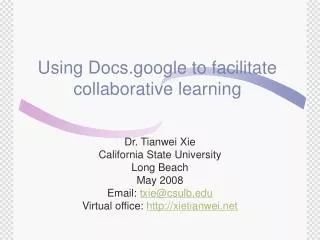
Using Docs.google to facilitate collaborative learning Dr. Tianwei Xie California State University Long Beach May 2008 Email: txie@csulb.edu Virtual office: http://xietianwei.net
Collaborative learning • Cooperative learning (CL) is an instructional paradigm in which teams of students work on structured tasks (e.g., homework assignments, laboratory experiments, or design projects)
Many studies have shown that when correctly implemented, cooperative learning improves: • information acquisition and retention • higher-level thinking skills • interpersonal and communication skills • and self-confidence. • Johnson, Johnson, and Smith.(1998). Active Learning: Cooperation in the College Classroom. Edina, MN: Interaction Book Company. <http://clte.asu.edu/active/baselemcooptms.pdf>
Programs for collaborative learning • writeboard.com • wikispaces.com • docs.google.com
writeboard.com • http://writeboard.com
Writeboard Discussion Links Password csulbchn360Lesson 8 • eric_chianghorng_david_yishyu • http://writeboard.com/afd521c40acb815f9 • Daniella_Jade_Ide_Brett_Mengxia' • http://123.writeboard.com/3077920e1e4982e03 • Lee_Fumi_Andrei_Yuko • http://123.writeboard.com/70dabf6fe3f1f4f6b
Wikispaces • http://www.wikispaces.com • http://chin360.wikispaces.com
Google Docs in Plain English • http://www.youtube.com/watch?v=eRqUE6IHTEA
Procedures of using docs.google • The first writer creates a draft • He/she invites co-writer(s) to access his/her draft. • All co-writers review and edit the draft. • When a final version is completed, it can be exported or saved in several formats (doc, rtf, htm, txt, pdf).
Features • It allows collaborative learning. • The process (reviewing and editing) can be synchronous or asynchronous. • Revision history (procedures of writing and editing) is recorded and each version can be retrieved.
Pilot project • Participants: second year students • Task: creating a dialogue • Procedures: • Form writing groups (2-3 students). • Students create free accounts and write collaboratively. • The instructor is "invited" as a collaborator of each group and monitorsstudents’ writing process and gives advises.
Some examples • An example of synchronous editing • An example of asynchronous editing 1 • An example of asynchronous editing 2
The result • The students like the project and their collaborative writing facilitated learning. • The essays/dialogues that students wrote were "longer" than usual writings. • The students were involved in discussion and negotiation. • More research should be done though to reach any plausible conclusion regarding the effectiveness of using this program.
Try it on • Go to http://www.google.com • Select More, Documents • Get started (to create free account) • Follow online instructions • Sign in
Create a word file and share with others • New Document • Type something • Share with others (invite collaborators) in your group • Members of each group work collaboratively (try synchronous or asynchronous editing)
Synchronous editing • Sign in • Open the same file • Working independently • Watch how others are editing