Relativistic Electron Mass
This study, conducted by James Durgin on April 30, 2009, focuses on the relativistic electron mass as particle velocity approaches the speed of light, revealing that the mass increases according to the formula (m = gamma m_0). Through rigorous experimental design involving beta decay emissions from Sr-90 and Y-90, the research measures electric and magnetic fields affecting electron motion under applied fields. Results demonstrate relativistic effects, with findings compared to accepted values, emphasizing the significance of calculating uncertainties and understanding non-linear behavior in experiments.

Relativistic Electron Mass
E N D
Presentation Transcript
Relativistic Electron Mass James Durgin April 30, 2009 Physics 521
Overview • Physical Theory • Experimental Theory • Experimental Design • Determining Magnetic Field • Determining Electric Field • Results/Uncertainty Analysis
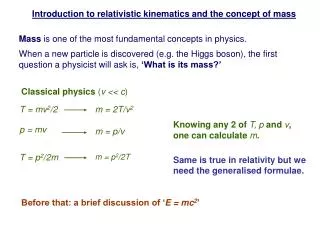
Physical Theory • Particle behavior changes as velocity approaches speed of light • Mass increases as v -> c m =γmo
Experimental Theory • Sr-90, Y-90 emit β-with energies up to 2.820 MeV • Applied magnetic field causes electrons to undergo uniform circular motion • An electric field can balance out the magnetic field by F=q(E+vxB) • Scintillator detects electrons
Determining B-field • 4 points measured along path • Standard deviation determines uncertainty • 3rd degree polynomial fit due to hysteresis
B Field (T) Uncertainty 0.00799579 0.001000276 0.0100598 0.00100011 0.01198767 0.00100002 0.01403391 0.001000053 0.01602358 0.001000201 0.01807416 0.001000461 0.01900479 0.002000266 Determining B-field • Uncertainty for calibration points used since similar currents
Determining E-field • 7 applied magnetic fields • 13 applied electric fields centered around peak per magnetic field • Points fit with Gaussian
Fitted Range B Field (T) Uncertainty Fitted Mean (V) Uncertainty X2 Probability 2.90 to 2.55 0.00799579 0.001000276 2734 10 39.08% 4.15 to 3.80 0.0100598 0.00100011 3992 16 7.87% 5.45 to 5.11 0.01198767 0.00100002 5202 21 88.60% 6.80 to 6.30 0.01403391 0.001000053 6528 7 47.68% 8.15 to 7.65 0.01602358 0.001000201 7854 14 18.96% 9.35 to 8.95 0.01807416 0.001000461 9181 19 99.33% 9.95 to 9.60 0.01900479 0.002000266 9801 55 5.26% Determining E-field
Results • Find m and β for each magnetic field • Take partial derivates to find uncertainty • Compare with accepted results • Find e/mo • Take partial derivates to find uncertainty • Compare with accepted result
e/m0 Uncertainty B Field (T) -1.69769E+11 2.332E+09 0.00797918 -1.70868E+11 2.337E+09 0.01005596 -1.69562E+11 2.345E+09 0.01198147 -1.68812E+11 2.408E+09 0.01401906 -1.69488E+11 2.748E+09 0.01600245 -1.67587E+11 3.044E+09 0.01805708 -1.67847E+11 3.427E+09 0.01899531 Results- e/mo Experimental: -169.1E9 ± 1.1E9 C/kg Accepted: -176E9 C/kg
Conclusion • Experiment demonstrates relativistic effects • Need to calculate partial derivates for non-linear experiments • Rotated Hall probe likely responsible for increased mass

![Theory of relativistic runaway electron avalanche (RREA) [3]](https://cdn2.slideserve.com/4706985/slide1-dt.jpg)