Understanding Covalent Bonding: Characteristics and Types
This guide explores the fundamental characteristics of covalent bonds, including how they form through sharing electrons among atoms to create molecules. It contrasts polar and nonpolar covalent bonds, highlighting differences in electronegativity and electron sharing. Key concepts include molecular and structural formulas, the octet rule, and the types of covalent bonds: single, double, and triple. The properties of molecules formed by covalent bonding, such as boiling points and conductivity, are also discussed, providing a comprehensive overview for students of chemistry.

Understanding Covalent Bonding: Characteristics and Types
E N D
Presentation Transcript
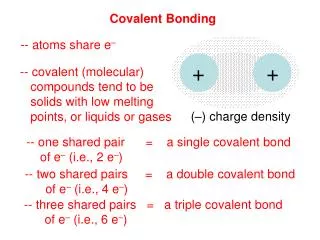
Covalent Bonding Objectives: • 1. Describe the characteristics of a covalent bond. • 2. Describe the difference between polar and nonpolar covalent bonds. Key Terms: • Molecule, molecular substance, molecular formula, structural formula, Lewis structure, unshared pair, single covalent bond, double covalent bond, triple covalent bond, polar, nonpolar
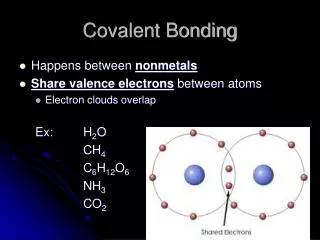
Covalent Bonds • A covalent bond is one where the electrons are shared. • A group of covalently bonded atoms is called a molecule. • These molecular substances include DNA, sugar and carbon dioxide. The molecules can contain as few as 2 atoms and as many as a million. • Rules for covalent bonds: • electrons are shared in covalent molecules • covalently bonded molecules follow the octet rule (some exceptions - BF3) • atoms will share electrons in order to fill their valence orbitals • covalent molecules can form single, double, or triple bonds • covalent bonds can be rearranged to form different molecules (glucose, fructose, & maltose)
Properties of Molecules • relatively low boiling points • present in all phases • poor conductors of heat and charge • usually dull in appearance • not malleable or ductile
Types of Covalent Bonds • Most covalent bonds are slightly polar in nature • Electrons are unequally shared between atoms due to electronegativity differences between the atoms • < 0.4 non-polar covalent • 0.4 – 1.9 polar covalent • > 1.9 ionic Example: Water (H2O) • electronegativity of H = 2.1 • electronegativity of O = 3.5 • Difference 3.5 – 2.1 = 1.4 polar covalent
Formulas - Empirical • lists atom ratios in the ratios that are present in the molecules • not good for describing covalently bonded molecules • (CH2O)n is wood, sugar, lactic acid, etc ...
Formulas - Molecular • lists the atoms in the found in the molecule without reducing • better that the empirical formula but not the best for describing molecules • C6H12O6 - fructose, C6H12O6 - glucose, C6H12O6 - galactose
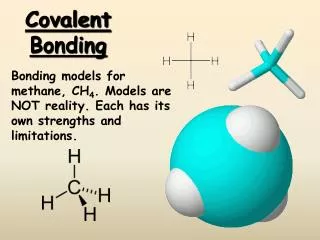
Formulas - Structural • shows where the individual atoms are bonded • Lewis structures are an example of this type of formula • Dashes are a shorthand way of showing bonds • Each represents 2 electrons
Formulas – Ball-n-Stick • shows the 3 dimensional structure of the molecule