Download
1 / 11
110 likes | 238 Views
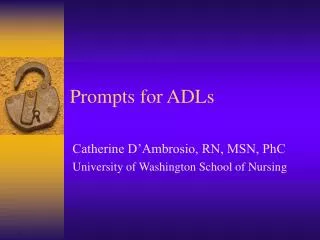
This presentation by Catherine D’Ambrosio, RN, MSN, PhD, highlights the importance of determining appropriate prompts for Activities of Daily Living (ADLs) focusing on mobility, problem severity, and cognitive status. Key areas covered include the assessment of functional mobility, cognitive impairment, and the utilization of various prompting cues to assist patients. By understanding these factors, healthcare providers can improve patient independence, manage nursing shortages, and address financial sustainability in care. The Folstein Mini-Mental Status Exam is discussed as a reliable tool for evaluating cognitive function.

E N D
Prompts for ADLs Catherine D’Ambrosio, RN, MSN, PhC University of Washington School of Nursing
Determining Appropriate Prompts for ADLs: • Mobility / Functional Status • Severity of Problem • Cognitive Status
Mobility • Hand grips • Lying to Sitting • Sitting to Standing • Stand & Pivot • Locomotion • Standing to Sitting • Sitting to Lying • Mechanical & Human Assistance req’d
Problem Severity • Regarding Functional Urinary Incontinence: FREQUENCY
Cognitive Status • Folstein Mini Mental Status Exam • Not comprehensive • Fairly superficial • Easy to administer • Low-stress for *patient* • Reliable and Valid measure of cog fx • Uniformly used and understood across a spectrum of settings
Level of Cognitive Impairment: • Why would it matter . . . to us?
Why is ASST COG imperative? • Federal & State Funding can’t sustain current rates of expenditure • Society demands independence & control • Nursing Shortage • Facts of Care
Mobility can be “prompted” • Grasping cues • Standing cues • Holding cues • Locomotion cues • Disrobing cues • Sitting cues • Toileting cues