Rough surface reflections
This study by Gregory Hart and Steve Turley at BYU delves into the complex phenomena of rough surface reflections in extreme ultraviolet (XUV) imaging. The research highlights why understanding these reflections matters for applications in astronomy and technology. By examining low reflectance surfaces and using numerical methods, the team correlates random roughness effects to improve imaging techniques. Acknowledgements go to collaborators in the Fulton Supercomputing Lab, emphasizing the role of parallel processing in handling these intricate cases.

Rough surface reflections
E N D
Presentation Transcript
Rough surface reflections Gregory Hart Steve Turley BYU XUV
Why do we care? • Astronomy • He • Computers • Photolithography • Microscopy • imaging BYU XUV
XUV • 1-100 nm • Low reflectance BYU XUV
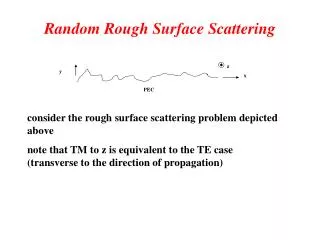
The Equations 0 =0 =0 BYU XUV
Numerically BYU XUV
Test BYU XUV
Test BYU XUV
Correlation BYU XUV
Discussion • The program works for simple cases • Found single processor limits • Random roughnesses have same overall effect • 2D surface • Parallel processing BYU XUV
Acknowledgement • Steve Turley • Jed Johnson • Fulton Supercomputing Lab • BYU Physics and Astronomy BYU XUV