Understanding Connective Tissue: Structure, Types, and Functions
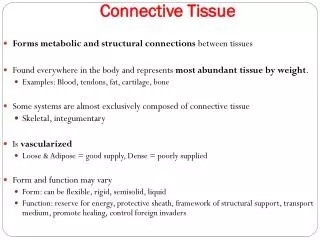
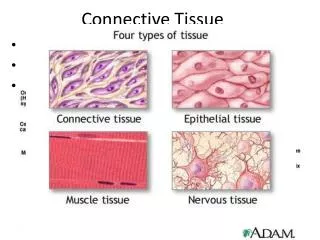
Connective tissue is an essential tissue type characterized by cells that are spaced apart and embedded in a matrix, which includes protein fibers and ground substance. It is not typically found on body surfaces and can vary from hard, as in bone, to liquid, as in blood. Key cells include fibroblasts, mast cells, macrophages, and adipocytes that play roles in support, immune response, and fat storage. The extracellular matrix contains diverse components, contributing to the properties of various connective tissue types such as loose, dense, cartilage, and embryonic mesenchyme.

Understanding Connective Tissue: Structure, Types, and Functions
E N D
Presentation Transcript
Connective Tissue • Features • Cells far apart with matrix between • Matrix • Protein fibers • Ground substance • Not usually on body surface • Can be hard to liquid • Bone and blood are connective
Vascular – except cartilage and tendons • High nerve supply- except cartilage
Connective Tissue Cells • Fibroblasts • Secrete the fibers and matrix of tissue • Mast Cells • Along blood vessels • Secrete histamine • Macrophages • Do phagocytosis, are white blood cells
Plasma cells – another white blood cell • Adipocytes • Fat storage cells
Extra cellular Matrix • Ground Substance • Contains different substances depending on tissue type • Can be watery or cement like • Hyaluronic acid is viscous and slippery for joints
Fibers • Collagen Fibers • Largest • Strong • Flexible • Collagen protein • Bone, cartilage, tendons, ligaments
Elastic fibers • Smaller than collagen • Promotes ability to stretch • Marfan’s • Reticular fibers • Smallest • Give support and strength • Stroma (framework) of some organs
Connective tissue types • Major types • Embryonic • mesenchyme • Loose connective • Areolar • Adipose • Reticular
Dense Connective • Dense regular • Dense irregular • Elastic connective • Cartilage • Hyaline • Fibrocartilage • Elastic cartilage