Download
1 / 22
220 likes | 404 Views
Characteristics of Life. Is it ALIVE?. M etabolism. All orgs… Take in E nergy for nourishment Convert E to useable forms Expel E in waste. R eproduction. Method to keep species alive Asexual & Sexual. R espond to S timulus.

E N D
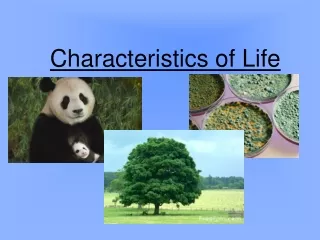
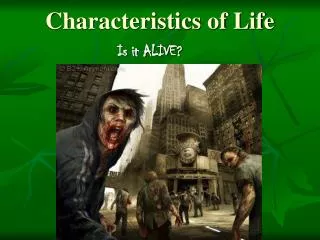
Characteristics of Life Is it ALIVE?
Metabolism • All orgs… • Take in Energy for nourishment • Convert E to useable forms • Expel E in waste
Reproduction Method to keep species alive Asexual & Sexual
Respond to Stimulus • Orgs must respond to internal and external stimuli
Evolution • Populations of orgs change their genetic make-up over many generations and adapt to surroundings
Development • Egg to mature adult
Cells • Prokaryotic cells do not have a membrane bound nucleus, eukaryotic cells do.
Cells Plant cells have cell walls, animal cells don’t
Homeostasis • Orgs must regulate their internal environment
Energy Autotrophs Heterotrophs
Growth • All orgs grow in size
MRS ED CHEG • Metabolism • Response to Stimulus • Reproduction • Energy • Development • Cells • Homeostasis • Evolution • Growth
Levels of Organization Atom: Oxygen
Levels of Organization Molecule: DNA
Levels of Organization Organelle: Nucleus Tissue: Ciliated Epithelial Tissue Cell: Goblet Cell
Levels of Organization Organ: Trachea Organ System: Respiratory
Levels of Organization Organism: Sheep Community Different species interacting in a common environment Population: Group of org’s of one species Ecosystem A community and its interactions with the non-living environment
What is the purpose of reproduction? • What are 2 types of reproduction? • Define Evolution • Give an example of something that has evolved. • What is the difference between growth & development? • Give an example of how a person can develop and grow. • Define homeostasis. • Give two example of homeostasis.
Give examples of the levels of organization from atom to organism. • Define metabolism. • Explain how metabolism is related to energy and development. • Explain how responding to stimuli can help an organism. • What is one thing that is different between plant and animal cells? • What is the difference between a eukaryotic and prokaryotic cell?