Traffic Signals 101
140 likes | 416 Views
Traffic Signals 101. Topic 1 Why?. Why?. Who initiates a signal? Developer City/County Politician Public State. Why?. Signal Warrants Traffic control signals should not be installed unless one or more of the signal warrants in the MN MUTCD are met


Traffic Signals 101
E N D
Presentation Transcript
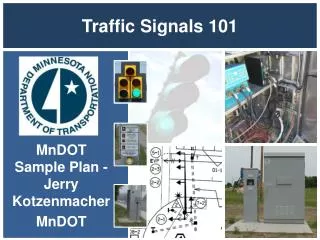
Traffic Signals 101 Topic 1 Why?
Why? • Who initiates a signal? • Developer • City/County • Politician • Public • State
Why? • Signal Warrants • Traffic control signals should not be installed unless one or more of the signal warrants in the MN MUTCD are met • The satisfaction of a warrant or warrants is not in itself justification for a signal • Information should be obtained by means of engineering studies and compared with the requirements set forth in the warrants • An Intersection Control Evaluation report needs to be prepared (see slide 8)
Why? • Signal Warrants • Warrant 1 - Eight-Hour Vehicular Volume • Warrant 2 - Four-Hour Vehicular Volume • Warrant 3 - Peak Hour • Warrant 4 - Pedestrian Volume
Why? • Signal Warrants • Warrant 5 - School Crossing • Warrant 6 - Coordinated Signal System • Warrant 7 - Crash Experience • Warrant 8 - Roadway Network • Warrant 9 - Intersection Near a Grade Crossing
Why? • Warrant 1 Example • The Minimum Vehicular Volume, Condition A, is intended for application at locations where a large volume of intersecting traffic is the principal reason to consider installing a traffic control signal • The Interruption of Continuous Traffic, Condition B, is intended for application at locations where condition A is not satisfied and where the traffic volume on a major street is so heavy that traffic on a minor intersecting street suffers excessive delay or conflict in entering or crossing the major street Warrant 1 tables
Why? 200 600
Why? • Intersection Control Evaluation (ICE) • In the past, the only perceived solution to traffic delay and safety problems for at-grade intersections was the installation of a traffic signal • Based on Signal Justification Reports (SJR) • Other options including stop control, roundabouts, and unconventional reduced-access intersections, may be acceptable alternatives ICE Book
Why? • ICE Definition • Intersection Control Evaluation, or ICE, is a process that identifies the best intersection control through a comprehensive analysis and documentation of the technical (safety and operational), economic, and political issues of viable alternatives
Why? • Purpose of ICE • Evaluate various intersection designs • Select the optimal control for an intersection based on an objective analysis for the existing conditions and future needs • Document all technical, financial, and political issues in the ICE Report • Replaces the SJR
Why? Signal & Lighting Certification • Cover Manuals Signal Design Manual (Update in 2012) Roadway Lighting Design Manual Minnesota Manual on Uniform Traffic Control Devices (MN MUTCD)
Why? Traffic Engineering Manual (TEM) • Cover Manuals Signal Optimization and Timing Manual Standard Specifications
Why? • For up-to-date information, visit: • http://www.dot.state.mn.us/trafficeng/