Download
1 / 15
280 likes | 394 Views
Explore psychosocial health concepts including mental, emotional, and social components, and learn how to enhance your well-being through positive steps and mindfulness practices. Discover the role of spirituality and the mind-body connection in improving overall health.

E N D
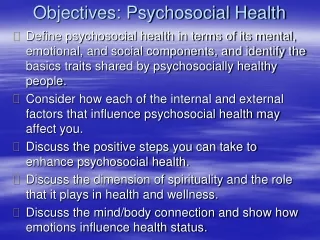
Objectives: Psychosocial Health • Define psychosocial health in terms of its mental, emotional, and social components, and identify the basics traits shared by psychosocially healthy people. • Consider how each of the internal and external factors that influence psychosocial health may affect you. • Discuss the positive steps you can take to enhance psychosocial health. • Discuss the dimension of spirituality and the role that it plays in health and wellness. • Discuss the mind/body connection and show how emotions influence health status.
Defining Psychosocial Health • The mental, emotional, social, and spiritual dimensions of health • Basic elements of psychosocially healthy people: • Feel good about themselves • Feel comfortable around other people • Can control tension and anxiety • Can meet the demands of life • Can curb hate and guilt • Can maintain a positive outlook • Enrich the lives of others • Cherish the things that make them smile • Value diversity • Respect nature
Psychosocial Health Figure 2.1
Mental Health: The “Thinking” You • The “thinking” part of psychosocial health • Includes: values, attitudes, and beliefs about your body, family, your relationships, and life in general
Emotional Health: The “Feeling” You • The “feeling” side of psychosocial health • Emotions – intensified or complex patterns of feelings
Social Health: Interactions With Others • Social Health – includes your interactions with others • Social Bonds – reflect level of closeness and attachment with others • Social Support – network of people and services (both tangible and intangible)
Spiritual Health: An Inner Quest For Well-Being • Spirituality – refers to a belief in some unifying force that gives meaning to life • Spirituality addresses four main themes: • Interconnectedness- connect to self, others, and larger purpose • Practice of mindfulness- being fully present in the moment • Everyday life- develop to our fullest potential; Faith, hope, love • Community- live in harmony
Four Major Themes Of Spirituality Figure 2.3
Mindfulness • Being fully present in the moment • Simply paying attention to what is happening • Objective awareness • Foundation of mindfulness: • Non-judging • Patience • Beginner’s mind • Trust • Non-striving • Acceptance • Letting go
Practicing Mindfulness • Diaphragmatic breathing • Mindful walking • Mindful writing • Mindful eating • Mindful meditation • Mindfulness in everyday tasks
Journal Entry #9 • Describe your experiences with mindfulness. • How could practicing mindfulness improve your health?
Factors That Influence Psychosocial Health • External Factors • The family • The broader environment • Social bonds • Internal Factors • Self-efficacy and Self-esteem • Learned helplessness versus Learned optimism • Personality • Life span and Maturity
Enhancing Psychosocial Health • Build self-esteem and self-efficacy • Find a support group • Complete required tasks • Form realistic expectations • Make time for you • Maintain physical health • Seek help when necessary
The Mind-Body Connection • Happiness • Subjective Well-Being • Satisfaction with present life • Relative presence of positive emotions • Relative absence of negative emotions
Satisfaction with Life Scale Figure 2.5