S ikhism
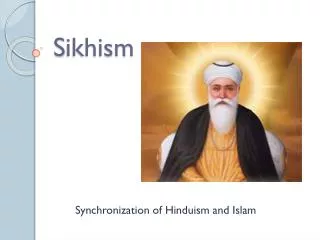
Sikhism, founded by Guru Nanak in the 15th century, promotes a monotheistic belief system that seeks to reconcile Hinduism and Islam. With around 25 million followers worldwide, Sikhs are recognized by their distinct turbans and the principles of equality and community. The Adi Granth serves as the eternal Guru, guiding adherents in their spiritual journey. Key practices include meditation, ethical living, and the formation of the Khalsa, an order emphasizing purity and devotion. Sikhs gather in gurdwaras for worship and shared meals, symbolizing community unity.

S ikhism
E N D
Presentation Transcript
Sikhism Synchronization of Hinduism and Islam
Basic Information • Founded by Guru Nanak 15c • Gu, darkness; ru, enlightenment; sikh, learner • Guru: successors of Nanak (10), • sacred text, • God • 23,000,000 Sikhs, Punjab, West India, 2,000,000 outside of India, (Recognizable by distinct turban) • Attempts to reconcile Hinduism and Islam • Kaur and Singh • Monotheistic • Salvation achieved by union with God and liberation from rebirth
Mythic • Guru Nanak • Hindu of the warrior caste • Decided after mediation and a mystical experience to follow God’s path • Built a township called Kartarpur, abode of the Creator, first Sikh community (Panth) • Body disappeared at death • 10 Successor Gurus • Founding of Khalsa • An order in Sikhism founded by Guru Gobind Singh • Installed the AdiGranth as the next Guru • Based on the principle of loyalty
Experiential • Union with God • God’s grace enables us to perceive God and to respond in meditation on God’s nature • Meditation on the divine name of God and repetition of his name is the path to spiritual perfection • Blissful and forever, beyond the cycle of death and rebirth • Liberation from samsara • Result of union with God
Doctrinal • Mool Mantra • Beginning of the AdiGranth, a description of God • Creator, preserver and destroyer • Immanent, indwelling in creation • Haumai • Humans insisting that they can do things on their own; lust, anger, greed, attachment, and pride increase the distance to God • Hukam • The divine order of the universe; God’s immanence is perceivable; God imposes His will on humans through Hukam
Ethical • Four Prohibitions • Prohibition against cutting of hair • Eating improperly slaughtered meat • Engaging in extramarital sexual relations • Using tobacco
Ritual • Ceremony of Initiation into Khalsa • 14 years old • Possess the 5 K’s (Uncut hair, a comb, iron wrist guard, sword or knife, pair of shorts) • Acceptance of the basic principles of Sikhism • Sprinkling of nectar and recitation of the Mool Mantra • Instruction on ethical requirements • Share special cake • Meditation on the divine Name • Worship practices in the gurdwara • Minarets, white paint • Congregate to worship • Evening, no particular day • Bathing, singing, reading from scripture, eating cake • Kitchen for community
Social • Panth • Name given to the entire Sikh community • Khalsa • An order within Sikhism that requires a particular purity. • Initiation into the order is ceremonial ritual
Material • Five K’s • Uncut hair, knife or sword, comb, iron wrist guard, pair of shorts • Food • Special cake; wheat, ghee, sugar, water- symbolizes unity within the community • Gurdwara • Central structure of a Sikh community • Holds the AdiGranth • AdiGranth • Compiled by the 5th Guru as the sacred scripture • Installed as the next Guru by Guru Gobind Singh • Holds a special seat in the Gurdwara • Written in Punjabi








![CP = E[ s 2 , s 5 , s 1 , s 3 , s 2 ’ , s 3 ’ , s 4 , s 1 ’ , s 4 ’ , s 5 ’ ] S[] I[]](https://cdn3.slideserve.com/6546826/slide1-dt.jpg)