Download
1 / 7
70 likes | 196 Views
This text explores the four fundamental states of matter: solids, liquids, gases, and plasma. It introduces the Kinetic Molecular Theory (KMT), which describes how all matter is composed of tiny, constantly moving particles. It explains how the kinetic energy of these particles varies with temperature, affecting their state. Additionally, the concept of thermal expansion is covered, highlighting how substances expand when heated and contract when cooled. This foundational knowledge is essential for understanding the physical properties of materials in various states.

E N D
MATTER Ch. 8 - Solids, Liquids, & Gases I. States of Matter (p.214-220) Kinetic Molecular Theory Four States of Matter Thermal Expansion
A. Kinetic Molecular Theory • KMT • Tiny, constantly moving particles make up all matter. • The kinetic energy (motion) of these particles increases as temperature increases.
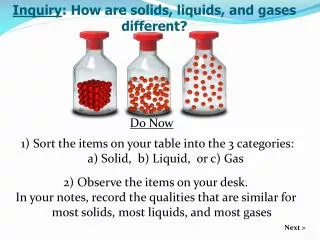
B. Four States of Matter • Solids • low KE - particles vibrate but can’t move around • definite shape & volume • crystalline - repeating geometric pattern • amorphous - no pattern (e.g. glass, wax)
B. Four States of Matter • Liquids • higher KE - particles can move around but are still close together • indefinite shape • definite volume
B. Four States of Matter • Gases • high KE - particles can separate and move throughout container • indefinite shape & volume
B. Four States of Matter • Plasma • very high KE - particles collide with enough energy to break into charged particles (+/-) • gas-like, indefiniteshape & volume • stars, fluorescentlight bulbs, TV tubes
C. Thermal Expansion • Most matter expands when heated & contracts when cooled. • Temp causes KE. Particles collide with more force & spread out. • EX: thermostats (bimetallic strip)