Download
1 / 1
10 likes | 130 Views
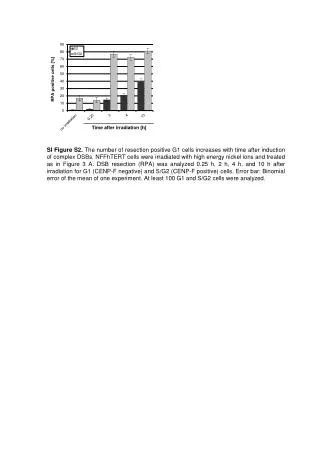
This study investigates the increase in resection-positive G1 cells over time following the induction of complex double-strand breaks (DSBs) in NFFhTERT cells irradiated with high-energy nickel ions. DSB resection (analyzed using RPA) was measured at various time points: 0.25 h, 2 h, 4 h, and 10 h post-irradiation, distinguishing between G1 (CENP-F negative) and S/G2 (CENP-F positive) cell populations. The analysis involved a minimum of 100 cells for each phase, with error bars representing binomial errors based on the mean of one experiment.

E N D
Time after irradiation [h] SI Figure S2. The number of resection positive G1 cells increases with time after induction of complex DSBs. NFFhTERT cells were irradiated with high energy nickel ions and treated as in Figure 3 A. DSB resection (RPA) was analyzed 0.25 h, 2 h, 4 h, and 10 h after irradiation for G1 (CENP-F negative) and S/G2 (CENP-F positive) cells. Error bar: Binomial error of the mean of one experiment. At least 100 G1 and S/G2 cells were analyzed.