Other Solar System Objects
The Kuiper Belt lies beyond Neptune's orbit (around 40 AU) and is home to a variety of small celestial bodies, including dwarf planets like Eris and Pluto. Unlike terrestrial and gas giants, these objects are composed of rock and ice. The Asteroid Belt exists between Mars and Jupiter, where planets couldn't form due to Jupiter's gravitational influence. Comets, small icy bodies with eccentric orbits, occasionally traverse the inner solar system, creating breathtaking meteor showers when Earth intersects their trails. Discover the complexities of our solar neighborhood.

Other Solar System Objects
E N D
Presentation Transcript
Other Solar System Objects Chapter 28.4
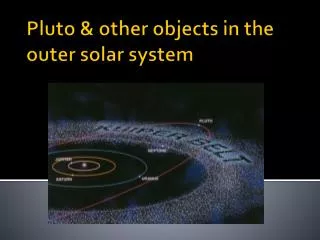
Kuiper Belt • Kuiper Belt • Lying outside of Neptune's orbit (40AU) • Eris – example of planetary bodies similar to Pluto • Should it be a tenth planet? • Objects most likely formed in this area • Asteroid Belt lies between Jupiter and Mars • Thought that planets never formed due to gravitational pull of Jupiter
How about Pluto? • Made of rock and ice • Different than both terrestrial and gas planets • Long orbit • Crosses Neptune’s orbit • Hasn’t been seen to make a complete orbit yet • 3 moons with orbits at sharp angles to the elliptical plane
New classification • Dwarf planet • Has its own gravity • Spherical • Orbits the sun • Includes • Pluto • Eris • Ceres – in Asteroid built • Many more objects are under debate
Asteroids • Thousands in the asteroid belt • Rocky, irregular shaped, pitted bodies • Many have small satellites orbiting them • Fragments of asteroid • Meteoroid – small fragment of an asteroid • Meteor – streak of light as meteoroid passes through earth’s atmosphere and burns • Shooting star • Meteorite – hits the earth
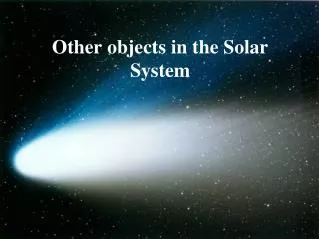
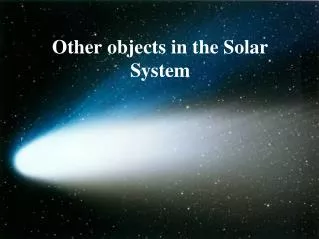
Comets • Small icy bodies • Extremely eccentric orbits • 1 to 10 km in diameter • Occasionally passes into the inner solar system • Pulled by gravity of objects in the solar system
Comets • They come close to the sun • Begins to evaporate • Forms a head and one or two tails • Solid core surrounded by gas and dust particles • Blown by the sun’s radiation, causing the bright tail
Meteor Shower • Earth enters an area where the comet had passed • Particles left behind from the comet burn as they enter the earth’s atmosphere