The Life and Death of Stars: Understanding Stellar Evolution on the Main Sequence
430 likes | 566 Views
This piece delves into the fascinating lifecycle of stars, from their formation on the main sequence to their ultimate demise. Stars spend approximately 90% of their lives engaged in stable hydrogen fusion, gradually transforming into helium and increasing in luminosity. Low-mass stars evolve into red giants before shedding their outer layers, while high-mass stars experience multiple fusion phases leading to supernova explosions. We explore the intricate processes behind these stellar evolutions, the temperatures involved, and the creation of heavy elements, enriching our universe.


The Life and Death of Stars: Understanding Stellar Evolution on the Main Sequence
E N D
Presentation Transcript
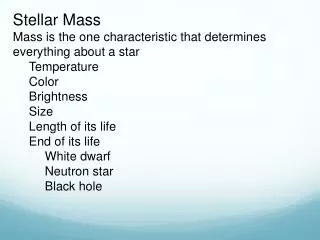
Life on the Main Sequence • Stable fusion: hydrogen helium • Accumulation of helium in core • Steady increase in luminosity • 90% of star’s life spent on main sequence • More mass shorter MS lifetime
Sun Low-mass stars: luminosity increases with age zero-age main sequence Luminosity Temperature
Change in composition of 1 solar mass star. Fusion ceases when core converted to helium – star now leaves main sequence.
Star Death I: Low Mass Stars (M < 8M)
Red Giant Surface cools, core contracts & heats, radius expands. ‘Evolutionary tracks’ p. 277
Vigorous H He fusion in shell drives envelope outward. Inert helium core (shrinking) Sun as a red giant p. 277
Red Giant: Aldebaran T = 3500 K L = 370 L R = 50 R M 3 M
* Core temp 100 million K: Helium fusion begins Another Helium Beryllium Gamma Ray Helium Carbon Gamma Ray
In addition . . . 12C + 4He 16O + gamma ray
Supergiant Core He exhaustion He ignition Horizontal branch On the HR diagram . . .
Helium-burning, Horizontal Branch star p. 279
Helium-fusing shell Hydrogen-burning shell Contracting carbon-helium core Supergiant Star
Old stellar core Planetary Nebula Ejected stellar envelope Ring Nebula * Supergiants lose mass: > Stellar winds > ‘Flashes’ in helium-burning shell p. 281
Old stellar core shrinking to White Dwarf state. Hourglass Nebula
The whole story . . . p. 280
Star Death II: High Mass Stars (M > 8M)
High temp., rapid fusion on CNO Cycle Again . . . hydrogen fusion ceases when core converted to helium – star now leaves main sequence.
core re-ignition core exhaustion Multiple core fusion stages are possible. p. 283
Core Fusion Core Temp Duration results in Iron For a 25 M star: H fusion 40 million K 7 million yr He fusion 200 million K 500,000 yr Carbon fusion 600 million K 600 yr Neon fusion 1.2 billion K 1 yr Oxygen fusion 1.5 billion K 6 mos Silicon fusion 2.7 billion K 1 day
As fusion ceases . . . ‘Onion Skin’ p. 283
Iron core contracts, heats Nuclei disintegrate Protons absorb electrons: proton + electron neutron + neutrino Core stiffens, bounces back slightly Core bounce + neutrino flow ejects envelope: SUPERNOVA!
Elements heavier than iron created in blast.
Before After Supernova 1987A
SN ejecta Stuff ejected before SN. SN 1987A in 1999
SN blast wave reaches inner ring
Neutrino arrival proton + electron neutron + neutrino SN 1987A (deep underground)
SN probably occur ~ once per 100 yrs in our galaxy.
600 mi/s Pulsar (rotating neutron star) Crab Nebula Supernova Remnant (Exploded 1054 AD) Visible in broad daylight for 23 days in July, 1054!
".. In the 1st year of the period Chih-ho, the 5th moon, the day chi-ch'ou, a guest star appeared south-east of Tien-Kuan [Zeta Tauri]. After more than a year, it gradually became invisible .."
Cygnus Loop ~13,000 BC
Vela Supernova Remnant (~10,000 BC) Interstellar medium ‘seeded’ with heavy elements.
Neutron star? Black hole? Cassiopeia A Supernova Remnant X-ray
Iron Silicon Cassiopeia A Supernova Remnant