Understanding Logarithmic Functions and Their Inverses: A Comprehensive Guide for Students
This guide introduces students to logarithmic functions, focusing on their conversion between exponential and logarithmic forms, solving equations, and understanding their graphical representation. Students will learn to solve equations of the form log_b(y) = x for various values, evaluate logarithms, and explore common logarithms. The relationship between exponential functions and their logarithmic inverses is emphasized, featuring step-by-step procedures to evaluate and solve logarithmic equations effectively. Ideal for students looking to strengthen their understanding of logarithmic concepts.

Understanding Logarithmic Functions and Their Inverses: A Comprehensive Guide for Students
E N D
Presentation Transcript
Logarithmic functions STUDENTS WILL BE ABLE TO: CONVERT BETWEEN EXPONENT AND LOG FORMS SOLVE LOG EQUATIONS OF FORM LOGBY=X FOR B, Y, AND X
Warm up: Solve the following • 1. 46=43x • 2. 8=x3 • 3. 27=3x • 4. x1/4=2
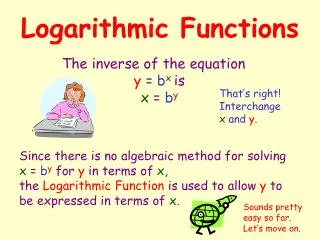
Inverses of exponential functions • We know what exponential functions look like as equations and as graphs • Let’s look at f(x)=2x • The inverse of f(x)=2x is a base 2 logarithmic function. • f-1(x)=log2x (“log base 2 of x”) • They share all the characteristics of inverses. • Reflection over the line y=x • Points are flipped
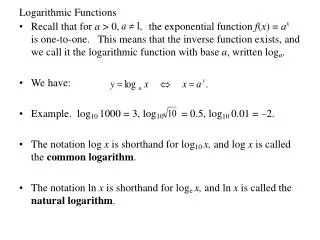
Logarithms • A logarithm to the base b of a positive number yis defined as follows: • If , then . • We know that a positive number b raised to any power x cannot equal a number y that is less than or equal to zero. Therefore, the log of a negative number or zero is undefined. Read as “log base b of y”
Converting • To convert between logarithmic and exponential form, just substitute the values into the appropriate places. • If , then . • If , then .
Evaluating Logarithms • Evaluate • Step 1: Write as an equation • Step 2: Convert to exponential form • Step 3: Write each side using the same base • Step 4: Power Property of Exponents • Step 5: Set the exponents equal • Step 6: Solve for x.
Common logarithms • A log in base 10 is called a common logarithm. • We can write as • The “log” button on your calculator evaluates common logs only
Solving log equations • This looks weird to most people (myself included!) so to solve this, we convert to exponential form. • Now it’s easy to solve! • Convert to exponential form. • Not quite as easy to solve, but still doable! • Base must be positive! • Convert to exponential form • Solve for x.