Understanding Direct Current Circuits: EMF, Resistance, and Circuit Analysis
This lesson provides an in-depth exploration of key concepts in direct current (DC) circuits, including Electro Motive Force (EMF), internal resistance, and the effects of series and parallel resistor arrangements. We will delve into Kirchhoff's Rules, which govern current and voltage in resistive circuits, and also cover RC circuits, detailing the processes of charging and discharging capacitors. Additionally, the lesson introduces essential electrical instruments such as galvanometers, ammeters, voltmeters, Wheatstone bridges, and potentiometers, enhancing your understanding of circuit measurement and analysis.

Understanding Direct Current Circuits: EMF, Resistance, and Circuit Analysis
E N D
Presentation Transcript
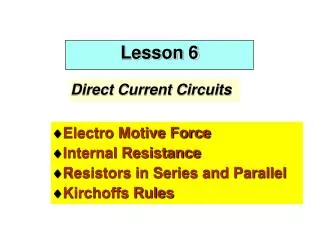
Lesson 6 Lesson 6 Direct Current Circuits • Electro Motive Force • Internal Resistance • Resistors in Series and Parallel • Kirchoffs Rules
Topics • RC Circuits • Charging • Discharging Capacitors • Electrical Instruments • Galvanometer • Ammeter • Voltmeter • Wheatstone Bridge • Potentiometer
EMF I Electro Motive Force (emf) Source of emf is any device that increases the potential energy of charges circulating in a circuit. Electric Potential increases by the emf Eas charge goes from negative to positive plate of battery.
EMF II EMF is Work Done per unit charge by electrical pump e dW = dQ
Charge Pump • Battery is a Charge Pump • Current flowing internally in battery feels a resistance this is an • Internal resistance, r • Flowing positive charges (current)experience drop of electric potential in resistor V=IR + - R
Internal Resistance - - - + + + Terminals • Terminal Potential Difference • V = E - Ir
Combination of Resistors Combinations of Resistors • Parallel • same electric potential felt by each element • Series • electric potential felt by the combination is the sum of the potentials across each element
Kirchoffs Rules I Kirchoff’s Rules The sum of the currents entering a junction must equal the sum of the currents leaving Conservation of Charge
Kirchoffs Rules II The Sum of the Potential Differences around a closed circuit loop must be zero Conservation of Energy
RC circuits RC Circuits • Non Steady State • Non Equilibrium • Current varies with time
Charging II q e - - = IR 0 C æ ö e d q dI 1 dq - - = = - - ç ÷ IR 0 0 R è ø dt C dt C dt dI I Û + = R 0 dt C dI 1 Þ = - dt I RC ò ò t I dI 1 Þ = - dt I RC I 0 0 æ ö t I t - ( ) Þ ç ÷ = - Û = ln I t I e RC 0 è ø I RC 0 e t - ( ) = RC I t e R
e Charging III t - ( ) = RC I t e R e t dq - = e RC dt R e t - Þ = RC dq e dt R ò ò q t e t - = dq e RC dt R 0 0 é ù é ù t t e - - e e ê ú ê ú ( ) RC RC Þ = - = - C q t 1 Q 1 ê ú ê ú ë û ë û
Discharging I Discharging +Q -Q q = IR from Kirchoff C dq = - I the rate of decrease of charge dt