Download
1 / 27
270 likes | 398 Views
This resource explores the intersection of paleontology, homology, and evolution, highlighting how paleontologists utilize derived characteristics of organisms to trace their evolutionary ancestry. By examining traits passed down from ancestral organisms, such as those of horses, whales, and other species, paleontologists can reconstruct the history of life on Earth. The La Brea Tar Pits serve as a rich source for studying fossils, allowing us to gather clues about the behavior, environment, and physical appearance of past organisms like the dire wolf and mammoth.

E N D
Paleontology, Homology, and Evolution May 22, 2013
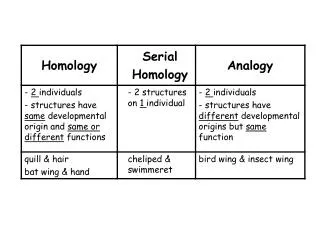
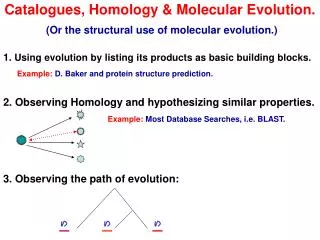
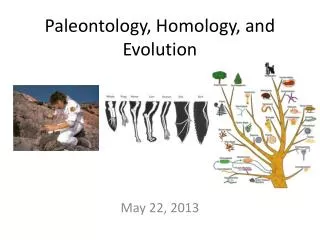
Paleontology, Homology, and Evolution • Paleontologists use homology to understand the evolution of organisms!
Paleontology, Homology, and Evolution • Paleontologists use homology to understand the evolution of organisms! DERIVED CHARACTERISTICS
Derived Characteristics • A trait that has been passed down from the ancestral organism
Derived Characteristics • A trait that has been passed down from the ancestral organism • Multicellular • Vertebrates • Mammals
Derived Characteristics • Trace back to understand evolution • Good example are horses and their ancestors • Using a number of morphological traits, they can trace back the ancestry of modern horses.
Paleontology • It is your job now to become the paleontologists and find what is in the soil.
Paleontology • Use the pictures of modern organisms to try and figure out what where the fossils come from!
What could you tell about the behavior or environment? • Fossils are found right here in LA at the La Brea tar pits. • Take a look at the fossils from the tar pits-what can we tell about these organisms? • How did they get trapped in the tar pit?
Other organisms • Camels (Camelopshesternus)
Other organisms • Ground Sloth (Paralmylodonharlani)
Other organisms • Mammoths (Mammuthuscolumbi)
Other organisms • Smilodon (Smilodonfatalis)
Other organisms • California dogwood (Cornuscalifornica)
Other organisms • White Sage (Salvia apiana)